How to Study Effectively: What the Evidence Says Works
Short answer
The two best-supported ways to study are testing yourself from memory and spreading study over several days. A 2013 review of ten common techniques rated only those two as high utility, and rated rereading, highlighting and summarising as low. Use self-testing as your default activity, space it across the week, and keep rereading for the first pass only.
Key takeaways
- Dunlosky and colleagues reviewed ten study techniques in 2013 and rated only practice testing and distributed practice as high utility.
- Rereading, highlighting, summarising, the keyword mnemonic and imagery for text were all rated low utility.
- In a survey of 177 students at a selective US university, 84% listed rereading as a study strategy and 55% ranked it first.
- In Roediger and Karpicke's 2006 experiment, rereading gave better recall after five minutes but self-testing gave better recall after two days and after a week.
- Students usually misjudge what works: 90% learned more from spaced flashcards in Kornell's 2009 experiments, yet 72% believed cramming had worked better.
- Learning-styles matching has no adequate evidence base, according to a 2008 review commissioned to check it.
How to study effectively comes down to two habits: test yourself from memory instead of rereading, and spread that testing over several days instead of one long session. Those are the only two of ten common techniques that the largest review of the research rated as high utility. Rereading, highlighting and summarising, which is what most students do, were all rated low.
The rest of this guide ranks the techniques, shows the experiments behind the ranking and turns them into a session you can run tonight.
Show the numbers
| Time until the final test | Read it twice | Read it once, then recalled it |
|---|---|---|
| 5 minutes | 81% | 75% |
| 2 days | 54% | 68% |
| 1 week | 42% | 56% |
Source: Roediger and Karpicke, 2006, Experiment 1 (120 students)
What are the most effective study techniques?
The best single ranking comes from John Dunlosky and four other psychologists, who in 2013 published a monograph-length review of ten study techniques. They picked techniques that students could use without special equipment or training, and judged each on whether its benefits held up across different learners, materials, kinds of test and real classrooms.
| Technique | Rating | What it is |
|---|---|---|
| Practice testing | High | Recalling material from memory: flashcards, practice questions, a blank page |
| Distributed practice | High | Spreading study of a topic over several sessions |
| Interleaved practice | Moderate | Mixing different kinds of problem or topic in one session |
| Elaborative interrogation | Moderate | Asking "why is this true?" of each fact |
| Self-explanation | Moderate | Explaining each step to yourself as you work |
| Summarisation | Low | Writing summaries of what you read |
| Highlighting or underlining | Low | Marking text as you read |
| Keyword mnemonic | Low | Linking a word to a similar-sounding image |
| Imagery for text | Low | Forming mental pictures while reading |
| Rereading | Low | Reading the text or your notes again |
Two points about how to read the table. "Low utility" does not mean useless. The authors write that summarising and imagery help some students on some tasks, and that rereading and highlighting "do not consistently boost students' performance". And "moderate" mostly means promising but under-tested: the review says the three moderate techniques fell short of a high rating because the evidence for them was limited, not because it was negative.
study techniques reviewed by Dunlosky and colleagues in 2013.
Dunlosky et al., 2013rated high utility: practice testing and distributed practice.
Dunlosky et al., 2013of 177 students surveyed at one selective university listed rereading as a study strategy.
Karpicke, Butler and Roediger, 2009Use the cards below to see each technique with what it suits. The ratings are Dunlosky's; the "good for" tags are a rule of thumb.
The ten techniques, by rating and by material
Filter by rating or by what you are learning. A starting point, not a prescription.
Close the book and produce the answer. Works for facts, concepts and problems, and it is the default to build every session around.
Come back to a topic on several different days. The longer you need to remember it, the wider the gaps should be.
Shuffle problem types so you have to work out which method applies. Feels harder than doing ten of the same kind in a row.
For each fact, ask why it is true and answer from what you already know.
Say what each step of a worked example does and why it follows from the last.
Takes training to do well, according to Dunlosky. Better used closed-book, which turns it into practice testing.
Fine for marking what to make questions from. Does little on its own.
Can help with vocabulary and names in the short term. Slow to build for most other material.
Picturing what a passage describes. The review found the benefits limited, and Dunlosky notes they can be short-lived.
Use it for the first pass through new material, then stop and start recalling.
Nothing matches all of those. Remove a filter.
The two that came top
Practice testing
Practice testing means pulling an answer out of your head before you look at it. It is also called retrieval practice or, among students, active recall. In the experiment charted above, students who read a passage once and then wrote down everything they could remember recalled 56% of it a week later, against 42% for students who used the same time to read it again. The quick version: after each section, close the book and write or say what it said, then check. The full method, with examples for different subjects, is in our guide to active recall.
Distributed practice
Distributed practice means returning to a topic on separate days. Dunlosky's summary for teachers calls the evidence for it over cramming "overwhelming". The useful detail comes from a study of more than 1,350 people who learned facts, reviewed them once after a gap, and were tested up to a year later: the best gap grew as the test got further away, from a day or two for a test in a week to roughly three to five weeks for a test in a year. How to turn that into review dates is covered in spaced repetition, and the spaced repetition schedule will work the dates out for you.
 Active Recall: The Study Method, With Examples
Why does rereading feel like it works?
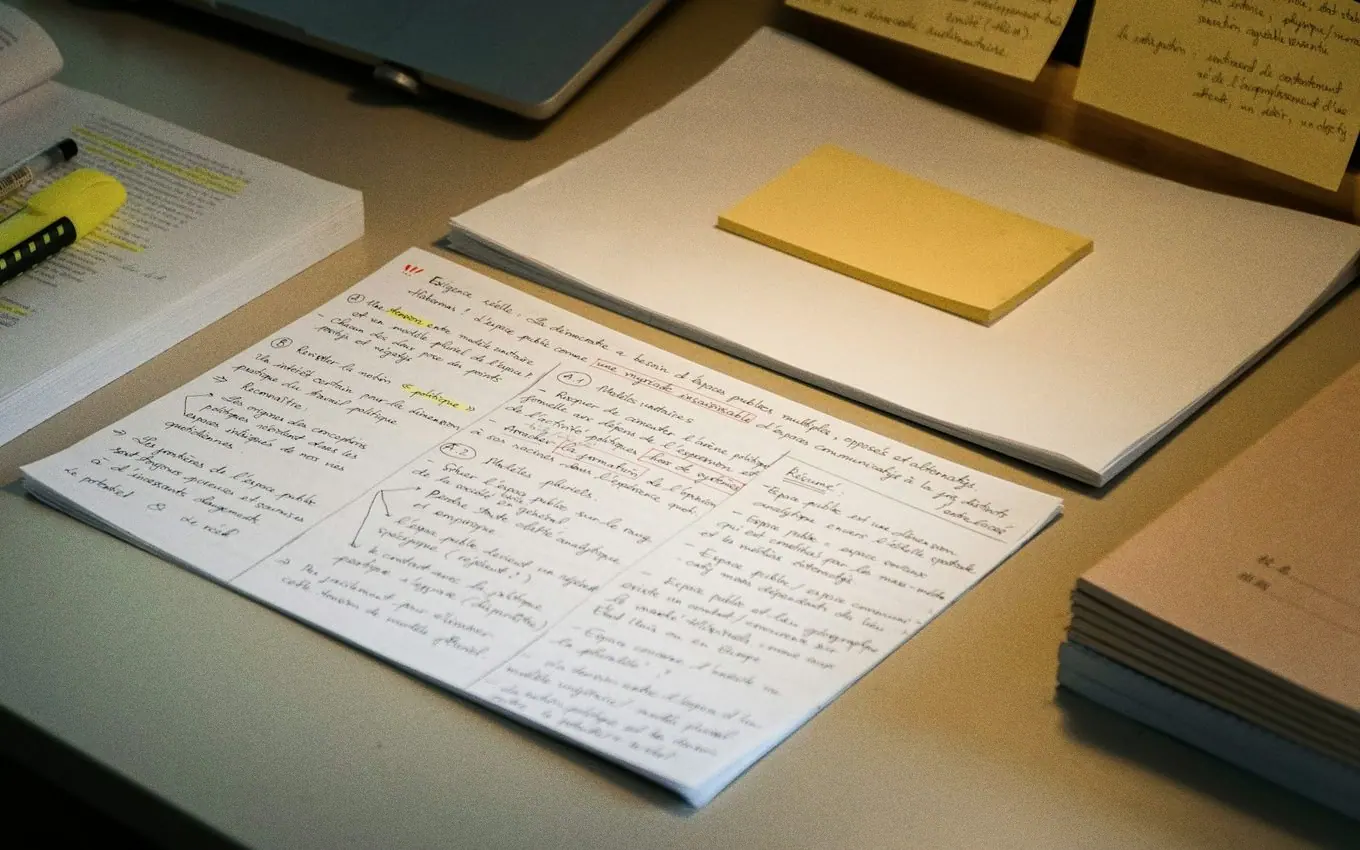
Because it makes the page familiar, and familiarity is easy to mistake for knowing. In the 2006 experiment, the students who reread were more confident about remembering the passage in a week than the students who had tested themselves, and they were wrong.
The same pattern shows up wherever researchers ask students to predict their own results:
Show the numbers
| Technique tested | Learned more with it | Believed the other method was as good or better |
|---|---|---|
| Spacing flashcards instead of cramming them | 90% | 72% |
| Recalling a text instead of concept-mapping it | 84% | 75% |
In Nate Kornell's flashcard experiments, spacing beat massed study for 90% of participants, yet after the first session 72% of those who saw a difference believed massing had worked better. In Karpicke and Blunt's 2011 study, 101 of 120 students did better on a test a week later after practising recall than after drawing a concept map with the text open, and 90 of the 120 had predicted concept mapping would be at least as good.
This explains what students do when left alone. In a survey of 177 undergraduates, most reported rereading their notes or textbook and relatively few tested themselves. The Dunlosky review reports the figures: 84% listed rereading, and 55% said it was the strategy they used most.
The three worth adding
- Interleaving. Mix problem types in one session. In a study with paintings, people learned to recognise artists' styles better when the artists were shuffled than when each artist's work was shown in a block, and most still rated the blocked version as more effective afterwards. Dunlosky's article for teachers describes a maths experiment in which students who practised mixed problem types scored about three times better on a test a week later than students who practised one type at a time. For maths and science, this means doing mixed past-paper questions, not ten of one type in a row.
- Self-explanation. Explain each step of a worked example in your own words. A 2018 meta-analysis of 64 research reports found a medium-sized benefit from prompting learners to explain. The Feynman technique is the popular form of this.
- Elaborative interrogation. Ask "why would that be true?" of each fact. It suits factual subjects where you already know enough to answer.
Study techniques for exams
For exams, the two top techniques merge into one activity: timed practice questions, started early and repeated at widening gaps. Three rules cover most of it.
- Start from the exam date and work back. Count the days with the exam countdown, then let the study schedule maker spread your subjects across them.
- Make every topic come round at least three times before the exam, with the gaps getting longer.
- Use past papers as the practice test, mixed across topics once you have covered them.
The day-by-day version, including what to do with only one day left, is in how to study for exams. To size the job first, put your hours of material and days left into the planner:
How many rounds a day until the exam?
Enter the hours of material you have and the days left. Treat each round as recall practice, not reading.
Study techniques for college and university students
University adds two problems: far more reading, and nobody checking that you did it. The techniques stay the same; the routine around them changes.
- Turn lectures into questions within a day. Notes are raw material for self-testing, which is why the layout matters. See how to take notes for methods that leave you with questions instead of a transcript.
- Plan the week, not the night. A fixed weekly timetable is what makes spacing happen without willpower. Our guide to making a study schedule shows how, and how many hours you should study covers the workload side.
- Read with a purpose. Before a chapter, write three questions you expect it to answer. More on this in how to focus while reading.
Study techniques for memorisation
For material that simply has to be memorised, such as vocabulary, formulae and dates, flashcards tested from memory and spaced over days are the core method. Mnemonics can help with arbitrary lists, though Dunlosky's review rated the keyword mnemonic low because its benefits were limited to certain materials and short delays. The full set of memory techniques, including memory palaces, is in how to memorise fast.
 Spaced Repetition: The Schedule and How to Use It
What does not help
- Matching your "learning style". A 2008 review set out what evidence would be needed to show that teaching visual learners visually (and so on) improves results, and found "virtually no evidence" of it. People have preferences; teaching to them has not been shown to raise scores.
- Marathon sessions with no breaks. Recalling takes more effort than reading, so plan it in short rounds with breaks; see how long to study before a break.
- Studying with a phone in reach. Every technique above assumes you are attending to the material. If that is the hard part, start with how to focus on studying.
How to switch from rereading without starting again
You do not need new materials. Each habit most students already have converts into a tested one with a small change.
| If you currently | Do this instead | Why |
|---|---|---|
| Reread the chapter | Read it once, close it, write what you remember, then check | Turns a low-rated technique into the top-rated one |
| Highlight as you read | Highlight, then write one question per highlighted line | The questions are tomorrow's self-test |
| Copy out notes neatly | Rewrite them from memory, then fill gaps in another colour | The gaps show you what to study |
| Do one topic per night until it is "done" | Split it across three shorter visits in the week | Spacing, at no extra cost in time |
| Work through ten similar problems | Mix problems from three topics | You practise choosing the method, as the exam requires |
| Revise only the night before | Start a week out and keep the last night for a final recall pass | Cramming alone fades fast |
Make one swap this week, not six. The swap that pays most is the first: closing the book.
How to study effectively in one evening: a session plan
Here is a two-hour evening that puts the ranking into practice: old material first, recalled from memory, then new material, then a closing self-test.
Show the numbers
| Schedule in minutes | |
|---|---|
| Hour 1: recall last week's and yesterday's topics | 25 focus, 5 short break, 25 focus, 5 short break |
| Hour 2: new topic, then test yourself on it | 25 focus, 5 short break, 25 focus |
Source: Example schedule
- Round 1 (25 minutes): last week's topic. Blank page, write everything you remember, then check against your notes and mark the gaps.
- Round 2: yesterday's topic. Flashcards or practice questions. Anything you miss goes back in the pile.
- Round 3: today's new material. Read or watch once, properly. This is where rereading and highlighting belong.
- Round 4: close the book and test yourself on round 3. Write questions for the gaps. They become next session's round 2.
If you prefer to time rounds without a fixed length, the study timer counts up and logs each session. The 25-minute structure is explained in the Pomodoro method for studying.
Date:
Round 1 (recall, a topic from last week):
Round 2 (recall, yesterday's topic):
Round 3 (new material):
Round 4 (closed-book test on round 3):
Gaps I found, to test next time:
Next review dates for today's topic:
Most failed sessions fail in the first five minutes, so set up before the timer starts.
Before you start tonight
Ticks are saved in this browser.
For a longer explanation from two researchers in this field (Robert Bjork co-wrote the paintings study above), this talk is a good use of 15 minutes.

Studying effectively with other people
Other people are the easiest source of practice questions. Swap five questions each at the start of a session, answer them closed-book, and mark each other's. Our guides to group study and studying with friends online cover how to keep that from turning into a chat.
If you study together remotely, Work Club gives the group one shared timer. The chat is locked for everyone during a focus round and opens on the break, which is a natural slot for quizzing each other: one person posts a question, everyone answers from memory before the next round starts.
Common questions
What is the most effective way to study?
Testing yourself from memory, spread over several days. Those are the only two of ten techniques that a 2013 review by Dunlosky and colleagues rated as high utility. Everything else is either a supporting technique or a way of getting the material into your head for the first time.
Is rereading notes a waste of time?
Not for a first pass, but it is a poor way to revise. The 2013 review rated it low utility, and in a 2006 experiment students who reread a passage recalled 42% a week later against 56% for students who read it once and then tested themselves. Reread to understand, then switch to recalling.
Does highlighting help you learn?
On its own, very little. Dunlosky and colleagues rated highlighting low utility. It can be useful as a first step if you then turn the highlighted lines into questions and test yourself on them.
How many hours should I study to study effectively?
Method matters more than hours. In one 2006 experiment, students who read a passage about 14 times recalled less a week later than students who read it about 3 times and tested themselves three times. Decide on the method first, then fit the hours to your course load.
Should I study according to my learning style?
There is no good evidence that it helps. A 2008 review found virtually none of the studies needed to show that matching teaching to a visual, auditory or other style improves results. Choose the method by the material instead: diagrams for anatomy, problems for maths.
What study techniques work best for exams?
Practice questions under exam conditions, spaced over the weeks before the exam, with different topics mixed together. That combines the two high-utility techniques with interleaving, which the 2013 review rated as promising, especially for problem solving.
Sources
- Improving Students' Learning With Effective Learning Techniques: Promising Directions From Cognitive and Educational Psychology, Psychological Science in the Public Interest (2013)
- Strengthening the Student Toolbox: Study Strategies to Boost Learning, American Educator (American Federation of Teachers) (2013)
- Test-enhanced learning: taking memory tests improves long-term retention, Psychological Science (2006)
- Retrieval practice produces more learning than elaborative studying with concept mapping, Science (2011)
- Metacognitive strategies in student learning: do students practise retrieval when they study on their own?, Memory (2009)
- Optimising Learning Using Flashcards: Spacing Is More Effective Than Cramming, Applied Cognitive Psychology (author's copy, Williams College) (2009)
- Spacing effects in learning: a temporal ridgeline of optimal retention, Psychological Science (2008)
- Learning concepts and categories: is spacing the "enemy of induction"?, Psychological Science (2008)
- Inducing Self-Explanation: a Meta-Analysis, Educational Psychology Review (2018)
- Learning Styles: Concepts and Evidence, Psychological Science in the Public Interest (2008)
Published 14 November 2026. Last checked and updated 14 November 2026. See how these guides are written.