Pomodoro for Studying: What to Do in Each 25 Minutes

Short answer
The Pomodoro technique helps you start and pace a study session, but the timer does not make you learn. Fill each 25 minutes with self-testing and spread each topic over several days, the two methods a major 2013 review rated highest, and use the 5 minute breaks to step away properly. Studies of timed study breaks show mixed results, so treat 25/5 as a starting point and adjust.
Key takeaways
- A 2013 review of 10 study techniques rated practice testing and distributed (spaced) practice as high utility, and rereading, highlighting and summarising as low utility.
- A pomodoro is a container: decide before the timer starts which question you will be able to answer when it rings.
- End most pomodoros with 3 to 5 minutes of closed-book recall, and open the next session on that topic with the same recall.
- In a 2023 study of 87 students, timed breaks came with less fatigue and better concentration than self-chosen breaks, but the amount of work completed was the same.
- For an exam about a week away, the spacing research points to revisiting a topic every one to three days instead of once in a single long sitting.
- A full revision day of 12 to 14 pomodoros is five to six hours of real focus, which is plenty for most people.
To use the Pomodoro technique for studying, work on one clearly defined piece of material for 25 minutes, take a 5 minute break, and take a longer break after four rounds. The timer gets you started and stops a session from sprawling. What decides whether you remember anything is what you do inside the 25 minutes: test yourself instead of rereading, and come back to each topic on several different days.
This guide covers the evidence, then gives you a plan for each type of study task, a sample revision day and an exam-week schedule. If you already know the method and only want the timetable, jump to the exam planner.
study techniques rated in the 2013 review. Only two, practice testing and spaced practice, were rated high utility.
Dunlosky et al., 2013of a passage recalled after one week by students who took a recall test, against students who restudied it.
Roediger and Karpicke, 2006students in the 2023 study of timed breaks. Less fatigue on a timer, the same amount of work completed.
Biwer et al., 2023Does the Pomodoro technique actually work for studying?
It helps with pacing and mood. The evidence that it makes you get more done is weaker than most study blogs suggest.
The technique was created by Francesco Cirillo, who began developing it in the 1980s while preparing for a university exam, using a tomato-shaped kitchen timer. So it was a study method from the start. If you want the full method, see our guide to the Pomodoro technique.
Here is what controlled studies with students have found:
- Timed breaks felt better in one study. Biwer and colleagues (2023) followed 87 Dutch university students through a day of real self-study. One group chose their own breaks. The others took a 6 minute break after every 24 minutes, or a 3 minute break after every 12 minutes. Students who chose their own breaks studied and rested for longer, and reported more fatigue and distraction and less concentration and motivation. The amount of work completed was the same in all groups.
- A later study found no advantage. Smits and colleagues (2025) gave 94 students a two-hour study session with either self-chosen breaks, 25/5 Pomodoro breaks, or "Flowtime" breaks (you choose when, the method sets how long). Fatigue rose faster in the Pomodoro group, but overall there were no differences between groups in fatigue, motivation, productivity, task completion or flow.
- Reviews are cautious. A 2025 scoping review found 32 studies of the technique, only three of them randomised trials. Most reported positive results, but the author notes that the studies varied widely in method, mostly measured short-term outcomes, and that fixed timing may interrupt tasks that need long, unbroken concentration.
A fair summary: a timer is a reasonable way to structure study and many students feel better using one. It is not proven to beat sensible breaks you choose yourself, and none of these studies shows that it improves exam marks. The bigger gains come from the study method you put inside the timer. If your real difficulty is sitting down in the first place, start with how to focus on studying and how to stop procrastinating, then come back here.
Which study methods should go inside a pomodoro?
The best single source on this is a 2013 review by Dunlosky and colleagues, who assessed 10 common learning techniques across different ages, materials and types of test. Their ratings:
| Rating | Techniques | What it means for you |
|---|---|---|
| High utility | Practice testing, distributed (spaced) practice | Make these the core of every session |
| Moderate utility | Elaborative interrogation (asking "why is this true?"), self-explanation, interleaved practice (mixing problem types) | Promising, with less evidence. Use them alongside testing |
| Low utility | Summarising, highlighting, the keyword mnemonic, imagery for text, rereading | Fine as a first pass, weak as your main method |
The review is blunt about the two most popular habits: most students report rereading and highlighting, yet these "do not consistently boost students' performance", and the authors suggest practice testing in place of rereading.
The photo below is what most revision looks like, and it is the part to shrink.
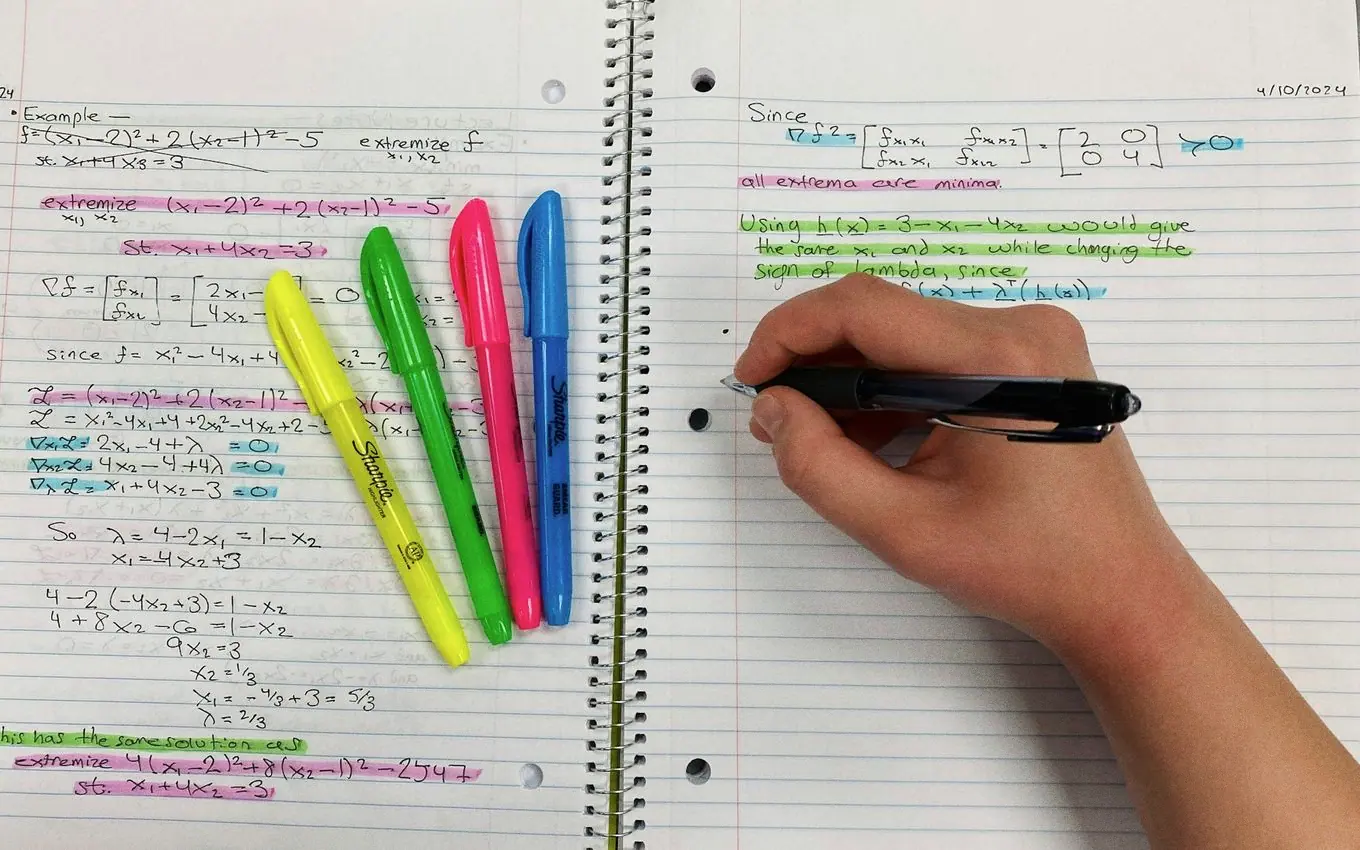
Two findings explain why.
Testing beats restudying over time. In a 2006 experiment by Roediger and Karpicke, students either restudied a passage or took a recall test on it. On final tests two days and one week later, the students who had been tested remembered substantially more, even though the students who restudied felt more confident. The full paper gives the figures for its first experiment, charted here.
Show the numbers
| Final test given | Restudied the passage | Took a recall test |
|---|---|---|
| 5 minutes later | 81% | 75% |
| 2 days later | 54% | 68% |
| 1 week later | 42% | 56% |
That crossover is why cramming by rereading feels as if it works: it does, for about as long as it takes to walk to the exam hall.
Spacing beats cramming, and the best gap depends on when your exam is. Cepeda and colleagues (2008) taught facts to more than 1,350 people, then varied the gap before a review session and the delay before the final test. The best gap was about 20 to 40 per cent of the delay when the test was a week away, falling to about 5 to 10 per cent when the test was a year away. For an exam in seven days, that works out at revisiting a topic every one to three days.
Pomodoro fits both. Short blocks make it easy to end with a quick test, and a day planned in pomodoros is easy to split between several topics so that each one comes round again later in the week.
For a five-minute visual summary of the same ideas, this TED-Ed lesson is a good one to watch on a long break.

How do you use Pomodoro to study, step by step?
- Write the target as a question. Not "chapter 6" but "explain how the kidney concentrates urine" or "questions 1 to 8 on integration by parts". One target per pomodoro.
- Clear the desk. Phone in another room or in a bag, only the tabs you need. If your phone is the main problem, see how to stop phone distraction.
- Start the timer for 25 minutes and work only on that target. If an unrelated thought turns up, write it on a scrap of paper and carry on.
- Spend the last 3 to 5 minutes on recall. Close the book and write or say what you now know. Mark the gaps.
- Take the 5 minute break away from the desk. Ideas are in our list of Pomodoro break ideas.
- After four pomodoros, take 15 to 30 minutes. Eat, walk, go outside.
- Tick the pomodoro off. A row of ticks is an honest record of how much you studied, which a count of hours at the desk is not.
Some people add background sound at step 2. Whether that helps depends on the task, and our guide to music for studying goes through what the research found. Then run through this before the first round.
Before you start the timer
The steps above as a two-minute setup. Ticks are saved in this browser.
The first item is where most sessions go wrong, so here is a template for it.
Subject:
Pomodoro 1 target (as a question):
Pomodoro 2 target:
Pomodoro 3 target:
Pomodoro 4 target:

After each one, from memory: what can I now answer?
Gaps to test again in 2 days:
What should you do inside each 25 minutes?
Each kind of task gets its own plan below. If you are not sure which one you are facing, filter the cards or let the button choose.
What to do in your next pomodoro
Short versions of the plans in this section. Rules of thumb, not prescriptions.
Skim the headings, write 3 questions, read to answer them, then answer from memory with the book shut.
Before opening your notes, write everything you remember about the last topic. Check and star the gaps.
Try each problem for up to 5 minutes before reading one line of the worked solution.
Shuffle problem types so you have to choose the method each time, then list the ones you got wrong.
Ten minutes to plan an answer to a past question without notes, then check it. Two plans fit in one round.
Write one section without editing, to a word target such as 250 words.
Five minutes on cards from earlier days, then new items in batches of 5 to 8: look, cover, recall, check.
Take the list of questions you missed two days ago and do them again without the solutions.
Nothing matches all of those. Remove a filter.
Reading a textbook or lecture notes
| Minutes | What to do |
|---|---|
| 0 to 2 | Skim headings and write 3 questions the section should answer |
| 2 to 18 | Read to answer those questions. Brief margin notes only, no highlighting marathon |
| 18 to 23 | Close the book. Answer your 3 questions from memory on a blank page |
| 23 to 25 | Open the book, correct your answers in a different colour, star what you missed |
The starred items become flashcards or the opening questions of your next session on that topic.
Problem sets (maths, physics, chemistry, statistics)
- Attempt each problem before looking at a worked solution. Give yourself a fixed limit, such as 5 minutes of being stuck, then read one line of the solution and continue.
- After solving, say in one sentence why the method worked. This is self-explanation, which the Dunlosky review rated as moderately useful.
- Mix problem types once you know the basics. Ten of the same kind in a row feels smooth, but it never makes you practise choosing the method. Mixing (interleaving) was rated moderately useful in the same review.
- Use the last 3 minutes to list the problems you got wrong. Redo them, without the solution, two days later.
For long problems or proofs, 25 minutes may cut you off mid-thought. Use 45 or 50 minute blocks with 10 minute breaks instead. Our guide to Pomodoro intervals compares the common patterns.
Essays and written coursework
Give each pomodoro a different job, so you are never staring at a blank page wondering what to do:
- Plan: write the question at the top, then a thesis sentence and 4 to 6 bullet points.
- Evidence: one pomodoro per section, collecting quotes, data and references under each bullet.
- Draft: write one section per pomodoro without editing. Set a word target such as 250 words.
- Edit: a separate pomodoro, ideally on another day, for cutting and checking references.
For exam essays, swap drafting for timed plans: 10 minutes to plan an answer to a past question from memory, then check it against your notes. You can fit two plans into one pomodoro.
Memorisation (vocabulary, definitions, dates, formulae, anatomy)
| Minutes | What to do |
|---|---|
| 0 to 5 | Test yourself on cards from previous days first |
| 5 to 20 | Learn new items in small batches of 5 to 8: look, cover, recall, check |
| 20 to 25 | Shuffle everything from this session and go through it once more. Put misses in a "tomorrow" pile |
Always produce the answer before you turn the card. Recognising an answer when you see it is much easier than recalling it, and the exam asks for recall.
What does a revision day look like?
This is an example for a full day with two subjects. Adjust the times, keep the shape.
| Time | Block | What happens |
|---|---|---|
| 09:00 to 10:55 | 4 pomodoros, Subject A | 1: blank-page recall of the last topic. 2 and 3: new topic, reading with questions. 4: closed-book recall of the new topic |
| 10:55 to 11:25 | Long break | Food, daylight, no notes |
| 11:25 to 13:20 | 4 pomodoros, Subject A | Past-paper questions on this week's topics, mixed. Mark them in the fourth pomodoro |
| 13:20 to 14:20 | Lunch | |
| 14:20 to 16:15 | 4 pomodoros, Subject B | 1: flashcards from earlier days. 2 and 3: problem set. 4: redo earlier wrong answers |
| 16:15 to 16:45 | Long break | |
| 16:45 to 17:40 | 2 pomodoros | 1: test yourself on this morning's Subject A topic. 2: write tomorrow's targets as questions |
Drawn to scale, the same day looks like this, next to a lighter version for days when you also have lectures.
Show the numbers
| Schedule in minutes | |
|---|---|
| Full day, 14 pomodoros | 25 focus, 5 short break, 25 focus, 5 short break, 25 focus, 5 short break, 25 focus, 30 long break, 25 focus, 5 short break, 25 focus, 5 short break, 25 focus, 5 short break, 25 focus, 60 other, 25 focus, 5 short break, 25 focus, 5 short break, 25 focus, 5 short break, 25 focus, 30 long break, 25 focus, 5 short break, 25 focus |
| Half day, 8 pomodoros | 25 focus, 5 short break, 25 focus, 5 short break, 25 focus, 5 short break, 25 focus, 30 long break, 25 focus, 5 short break, 25 focus, 5 short break, 25 focus, 5 short break, 25 focus |
Source: Example schedule from the table above
That is 14 pomodoros, a little under six hours of focused work. If your recall is poor by the last block, drop it. The morning topic comes back in the late afternoon on purpose: it is a small dose of spacing inside one day, and tomorrow's first pomodoro repeats it again.
How should you plan exam week?
Work backwards from the exam and make sure every topic is tested at least three times on different days.
| Days before exam | Focus | Pomodoros per topic |
|---|---|---|
| 7 to 5 | Cover every topic once: read with questions, then recall | 2 to 3 |
| 4 to 3 | Second pass, closed book first. Past-paper questions by topic. Fix gaps | 2 |
| 2 | Full past paper under timed conditions, in one long block, then mark it | Paper length, then 2 for marking |
| 1 | Light day. Redo wrong answers, go through the "missed" flashcard pile, stop by early evening | 4 to 6 in total |
Three rules keep this honest. Start each session on a topic with recall, not with your notes. Keep a single list of everything you got wrong, because that list is your revision for the final two days. And sit at least one full past paper without the timer breaking it up, since the exam will not pause every 25 minutes. That long sitting is a skill of its own, and the planning advice in deep work sessions applies to it.
To turn the table into numbers for your own exam, enter roughly how many hours of material you have and how many days are left.
How many pomodoros a day do you need?
It divides your material across the study days you have. Treat the answer as a planning estimate, and keep the last day light.
If the number it gives you is more than about 14 rounds a day, the plan is too big for the time. Cut the material to the topics most likely to come up before you cut sleep.
What are the common mistakes?
- Counting pomodoros of rereading. Eight ticked boxes of highlighting is still highlighting.
- Vague targets. "Revise biology" gives you nothing to test at the end.
- Breaks on your phone. A five minute break that turns into twenty is the most common way the method fails.
- Treating 25 minutes as a rule. The studies above tested 12, 24 and 25 minute blocks and did not find a winner. If you are in the middle of a problem when the timer rings, finish the step. For more on choosing a length, see how long you should study before a break.
- One topic all day. Splitting the day between topics is what makes spacing possible.
 How Long Should You Study Before Taking a Break?
Studying this way with friends
If revising alone is where it falls apart, a shared timer can help you turn up and stay put. Some people get the same effect from an accountability partner who checks in on their targets, and group study has its own rules for staying on task.
Work Club is a free browser room with one timer for everyone, set to 25/5 with a 15 minute break after every fourth round by default, and you can change the lengths. Chat is locked during focus and opens on breaks, which is a good moment to quiz each other on what you just covered. It has no task lists or scheduling, so agree a start time with your group yourselves.
There is more in our guide to using a Pomodoro timer with friends, and a full walk-through of setting up sessions in how to study with friends online. If you would rather drop into a room that is already running, see our comparison of virtual study rooms.
 How to Study With Friends Online (Without It Becoming a Hangout)
Whichever timer you use, the method is the same: a question to answer, 20 minutes of work, a few minutes of recall, a real break, and the same topic again in a day or two.
Common questions
Is the Pomodoro technique good for studying?
It is good for getting started and for pacing a long session. In one 2023 study, students on timed breaks reported less fatigue and better concentration than students who chose their own breaks, though both groups completed the same amount of work, and two later studies found no clear advantage. What you do inside the 25 minutes matters more than the timer.
How many pomodoros should I do a day when revising?
There is no researched number. As a practical guide, 8 to 14 pomodoros (about three and a half to six hours of focused work) is a full day for most students. Count the ones where you were really working, and stop when the quality of your recall drops.
What should I do in the 5 minute break?
Leave the desk. Stand up, get water, stretch, look out of a window. Avoid starting anything that is hard to stop after five minutes, such as short-form video or a group chat, because the break is only useful if you come back when it ends.
Is 25 minutes too short for studying?
For flashcards, reading and short problems it is usually fine. For essays, long proofs and past papers under timed conditions it can be too short, so use 45 or 50 minute blocks with 10 minute breaks for those. Research has tested schedules from 12 to 25 minutes and has not shown that one length is best.
Can I use Pomodoro for memorising?
Yes, and it suits it well. Spend the block testing yourself with flashcards or a blank page instead of rereading notes, mark what you got wrong, and come back to those items a day or two later. Short blocks spread over several days beat one long block.
Does the Pomodoro technique work for exam week?
It works as the timetable, as long as the content is past-paper questions and recall. Plan each day in blocks of four pomodoros, mix subjects across the day, revisit each topic at least twice before the exam, and keep the last day light.
Sources
- Improving Students' Learning With Effective Learning Techniques: Promising Directions From Cognitive and Educational Psychology, Psychological Science in the Public Interest (PubMed record) (2013)
- Test-enhanced learning: taking memory tests improves long-term retention, Psychological Science (PubMed record) (2006)
- Test-Enhanced Learning: Taking Memory Tests Improves Long-Term Retention (full text), Psychological Science, hosted by the Cognition and Learning Lab, Purdue University (2006)
- Spacing effects in learning: a temporal ridgeline of optimal retention, Psychological Science (PubMed record) (2008)
- Understanding effort regulation: Comparing 'Pomodoro' breaks and self-regulated breaks, British Journal of Educational Psychology (PubMed record) (2023)
- Investigating the Effectiveness of Self-Regulated, Pomodoro, and Flowtime Break-Taking Techniques Among Students, Behavioral Sciences (MDPI) (2025)
- Assessing the efficacy of the Pomodoro technique in enhancing anatomy lesson retention during study sessions: a scoping review, BMC Medical Education (PubMed Central) (2025)
- What Is the Pomodoro Technique?, Francesco Cirillo, pomodorotechnique.com (2026)
Published 12 November 2026. Last checked and updated 13 November 2026. See how these guides are written.