Study With Me: Videos, Live Streams and Rooms

Short answer
A study with me video is a real-time recording or live stream of someone studying quietly, which you play while you do your own work. The format grew out of South Korean study broadcasts called gongbang around 2018 and spread widely in 2020. The one detailed study of viewers found they use the videos for motivation, company and a controllable study atmosphere, but nobody has measured an effect on grades. Pick a video whose timer matches how you work, or use a live room or a room with friends if you need someone who notices whether you turn up.
Key takeaways
- A study with me video shows one person studying in real time with little or no talking, often with a timer on screen and rain, café or lo-fi sound.
- The Korean name is gongbang, short for gongbu bangsong or study broadcast; English-language coverage of the trend dates from 2018.
- A 2021 study of 30 videos and 12 viewers found people watch to get motivated, feel less alone, control the atmosphere cheaply and keep off their phones.
- That study relied on interviews with 12 viewers, 11 of them women, and no research has tested whether the videos improve marks.
- Choose by length, timer and sound: viewers in the study said a timer that did not match their own rhythm broke the feeling of studying together.
- A video gives company without accountability; a live room, a Discord server or a room with friends adds people who can tell whether you are there.
A study with me video is a real-time recording or live stream of someone studying quietly, which you play while you get on with your own work. Nobody teaches and hardly anyone speaks: it is company for your desk. The format grew out of South Korean study broadcasts and spread widely in 2020. The research on it is thin but consistent about why people watch, and it points to a simple way to choose one: match the video's length, timer and sound to how you work.
If you would rather skip to the options, jump to the picker.
What is a study with me video?
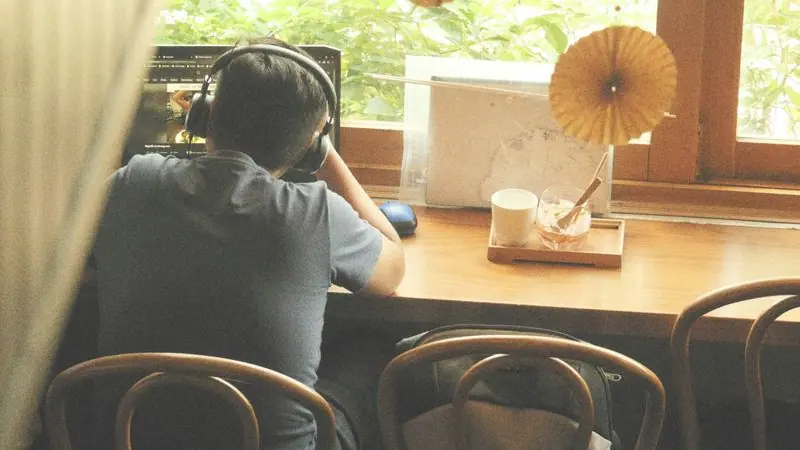
It is footage of one person at a desk, studying, for a long time. A typical video has a fixed camera, a visible desk, a timer in the corner, and either silence or soft background sound such as rain, a café or lo-fi music. Some creators show their face, some show only hands and notes.
Researchers at KAIST in South Korea gave the first systematic description in a 2021 paper presented at the CHI conference. They sampled 30 YouTube videos and found that 29 showed a single person, 14 had a timer on screen, 16 showed the creator's face and half used music or ASMR. The creator spoke to viewers in only 10. Lengths ran from 45 minutes to 24 hours, averaging 5 hours 45 minutes, and there were more recordings than live streams.
The same paper defines what the genre leaves out: there is no conversation and no instruction. That is what separates it from a tutorial, a study vlog or a study group. You are not learning from the person on screen. You are working next to them.
average length of the 30 study with me videos sampled. The shortest ran 45 minutes and the longest 24 hours.
Lee et al., CHI 2021rise in US views of videos titled "study with me" in 2020 over 2019, a YouTube figure reported in the paper.
Lee et al., CHI 2021interviewed viewers said comparing themselves with the person studying on screen spurred them on.
Lee et al., CHI 2021Where did study with me come from?
The best-documented starting point is South Korea. There the format is called gongbang, which ABC News explains is short for gongbu bangsong, or "study broadcast". The name follows mukbang, the eating broadcast.
A rough timeline from reports published at the time:
- April 2018. Tubefilter, citing Kotaku, reports that "benkyou douga", or study clips, are finding large audiences in Japan, and that American creators are making them too. It names The Strive Studies as a channel "completely dedicated to the genre", with 80,000 subscribers at that point.
- June 2018. The Korea Herald profiles a creator known as Bot-No-Jam, reported to be preparing for a police exam, who had been live-streaming himself studying since that April in six-hour sessions titled "Study With Me". He had about 320,000 subscribers.
- 2020. Schools, universities and libraries close. The CHI paper reports, citing YouTube, that US views of videos with "study with me" in the title rose 54% in 2020 over 2019.
- 2021. Vice describes the genre as having first gained traction in South Korea and spread to creators in the United Kingdom, Argentina and Singapore, with most videos running two to four hours.
Two cautions on that history. "Since 2018" is when English-language outlets noticed, and ABC's report says only that the trend "has actually been around since 2018"; none of these sources identifies a first video. And the 54% figure covers the United States only, and the paper's reference for it was accessed in September 2020, so it cannot describe the whole year.
Do study with me videos actually work?
People who watch them say they help. Nobody has yet measured whether they do.
The main evidence is the 2021 CHI paper. Alongside the video analysis, its authors interviewed 12 regular viewers and found five reasons for watching:
- To get motivated by someone who is visibly working.
- To feel they are studying together, which the paper files under emotional support. Viewers described loneliness from studying at home during the pandemic, late at night or abroad.
- To control the atmosphere. A video lets you choose the time, the look and the sound, which a library does not.
- To get that atmosphere cheaply, without finding motivated people to sit with.
- To stay off their phones, sometimes simply because the phone was busy playing the video.
Although I was alone, I wanted to feel that someone is studying around me.
The paper names which participants said what, so the pattern can be counted.
Show the numbers
| What they described | Viewers (of 12) |
|---|---|
| Spurred on by comparing themselves with the creator | 11 viewers |
| Stayed at the desk longer | 6 viewers |
| Kept the video behind other windows, for the sound only | 6 viewers |
| Felt lonely studying alone | 5 viewers |
| Motivated by the number of live viewers | 3 viewers |
| Used their phone less because it was playing the video | 2 viewers |
One detail is easy to miss: half of them were not watching at all. They put the window behind their work and listened, and two covered the screen and muted it, keeping the video running only for the sense that someone was there.
The second piece of evidence comes from research on body doubling, which means using another person's presence to start or stay on a task. A 2024 survey of 220 people, most of them neurodivergent, reports that a body double "can be collocated or remote, recorded or live, known or a stranger", and lists YouTube videos among the ways people do it.
So the fair summary is this: a video can make starting easier and sitting alone less bleak, for some people. It does nothing for the quality of the studying itself. What you do during the session still decides what you learn, and that is covered in how to focus on studying.
 Body doubling: what it is and whether it works
Study with me on YouTube: how do you choose a video?
Table 2 of the CHI paper lists the features viewers selected on, and it makes a good checklist.
- Length. Pick one that fits the time you have. Viewers liked recordings because they could choose a length and start when they wanted.
- Timer. A timer on screen gave viewers a sense of how long they had worked. A timer that did not match their own rhythm broke the feeling of studying together, and some ignored the creator's timer altogether.
- Sound. For several viewers sound was the deciding feature. Some wanted a particular ASMR or ambient track, and some muted the video. If you are unsure whether sound helps you, see music for studying and white, brown and pink noise.
- Face. A visible face motivated some viewers and distracted others, who covered that part of the screen.
- Talking. Viewers avoided videos where the creator chats. Silence is the point.
- Field. Some chose creators in their own subject, or at a stage they aspired to, such as medical students.
Here is an example of the form: a two-hour session with no music from The Strive Studies, the channel Tubefilter singled out in 2018. The University of California, Irvine's business school includes it in a list of virtual study sessions for its students.

Study with me for 2 hours: what fits?
Two hours is a common length for these videos, and it divides neatly. Both schedules below give 100 minutes of work.
Show the numbers
| Schedule in minutes | |
|---|---|
| 25/5, four rounds | 25 focus, 5 short break, 25 focus, 5 short break, 25 focus, 5 short break, 25 focus, 5 short break |
| 50/10, two rounds | 50 focus, 10 short break, 50 focus, 10 short break |
Source: Arithmetic, not measured data
Short rounds suit revision and tasks you are avoiding; long rounds suit essays and problem sets. The reasoning is in Pomodoro for studying, and the Pomodoro calculator shows what fits any other length.
Study with me with a Pomodoro timer
Many videos are built around the Pomodoro Technique, with a countdown on screen. That is useful when the creator's intervals are yours, and a nuisance when they are not.
If the video's timer does not suit you, run your own and treat the video as scenery:
- For fixed rounds, open a Pomodoro timer in another tab and mute the video's bell.
- To simply record how long you studied, use a count-up study timer, which keeps a session log and a daily total.
Not sure which interval is yours? Our comparison of Pomodoro intervals shows where 25/5 and 50/10 come from and how to test them in a week.
Study with me live: stream, or a room with real people?
A live stream adds one thing to a recording: it is happening now. In the CHI study, three viewers said the count of people watching motivated them, and one said a streamer who had already started in the morning got him to his desk early. Others saw no benefit in liveness and preferred to start on their own schedule.
A stream is still one-way. The creator cannot see you, and nothing happens if you leave. That is the line between the two things people mean by "study with me live":
| Live stream | Live study room | |
|---|---|---|
| Who can see you | Nobody | Others, if you turn a camera on |
| Does anyone notice if you leave | No | Sometimes |
| Effort to join | Press play | Join a call or a site, sometimes an account |
| Timer | The creator's | The room's, shared |
| Best for | Company with no social effort | Company plus a little pressure |
If a stream leaves you drifting, the usual next step is a room where presence runs both ways. The researchers who study body doubling describe this as moving up in mutuality, and our guide to virtual body doubling walks through the levels.
Study with me online: websites and rooms
Beyond YouTube there are sites where the people studying are live and there are many of them. These are covered properly elsewhere, so briefly:
- Public study rooms. Services with open rooms around the clock, where strangers sit on camera or with cameras off. Our comparison of the best online study rooms covers what each offers and what it costs.
- One example. Study Together's FAQ, as of November 2026, describes its study rooms as free and open 24/7, run through its website on Zoom and on a Discord server. Cameras are optional, and its timer runs 50 minutes followed by a 10 minute break.
- University rooms. Some libraries and student services host their own sessions. See virtual study rooms for how these work.
Study with me on Discord
Discord study servers work like a library with many rooms. You join a server, enter a voice channel, usually muted, sometimes with camera or screen share expected, and study while a bot runs the timer. Study Together's FAQ describes its own Discord server as having "different study channels", and many of the large public rooms have a Discord side.
The same mechanics work privately. A server with three friends and one voice channel is a study with me stream where everyone is both the creator and the viewer. Setting that up is covered in how to study with friends online.
Study with me with your own friends
A stranger on screen cannot ask where you were yesterday. Friends can, and that is the difference between company and accountability.
The simplest version is a video call on mute with cameras on desks. The cleaner version is a room with one timer, so everyone starts and stops together. Work Club does this in the browser: type a name, get a link and a 6-character code, and send it. Everyone shares a 25 minute focus timer with 5 minute breaks by default, the chat is locked during focus and opens on breaks, and cameras and voice are optional. It is free and needs no account. It does not schedule sessions or match you with strangers, so you need at least one person to invite, or a public room that a host has listed.
Plan the session before you send the link. Set a start time and a length and copy the timed plan into your group chat.
Plan a study with me session for your group
Pick a start time, a length and an interval. Copy the plan and send it with the room link.
A message along these lines is enough to get people there.
Study with me tonight? 7pm to 9pm, cameras optional.
Four rounds of 25 minutes, chat on the breaks.
Bring one thing you want finished by 9.
Link: [paste room link]
More on running these, including how to pick the interval for a group, is in Pomodoro timer with friends.
 Pomodoro Timer With Friends: 4 Ways to Share One Clock
Which kind of study with me suits you?
Filter by what you want from the session. This restates the options above as a rule of thumb.
Ways to study with someone
From least to most social. Start low and move up if you keep drifting.
Start any time, choose the length and sound. Nobody can see you and nobody notices if you stop.
The same, but happening now, with a viewer count and a chat. Still one-way.
A site with open rooms of strangers. Camera optional on the large ones.
Voice channels with a timer bot. Public servers for strangers, or your own for friends.
On mute, cameras on desks. Agree a start time and an end time.
One countdown for everyone and chat on the breaks, with optional cameras.
The original. Real people, no screen, and no choice of soundtrack.
Nothing matches all of those. Remove a filter.
When does study with me not help?
It is company, not a method, and it has predictable failure points.
- You end up watching. If your eyes keep going to the video, do what half the interviewed viewers did: put it behind your work and keep only the sound.
- It opens the wrong app. Going to YouTube for a study video is one tap from everything else on YouTube. Start the video from a saved link, full screen, and deal with the phone before you sit down.
- The comparison turns sour. Eleven of twelve viewers were spurred on by the creator's effort. A twelve-hour stream can also make a normal day feel inadequate. Hours at a desk are a poor measure, as our guide to how many hours you should study explains, and pushing to match someone else's total is one route to study burnout.
- You needed accountability, not ambience. If you close the tab after ten minutes and nothing happens, move up to a room with people in it.
- Motivation is the deeper problem. A video can help you start today. It will not answer why the work feels pointless, which is the subject of how to stay motivated to study.
Before you press play
Two minutes of set-up. Ticks are saved in this browser.
Common questions
What does study with me mean?
It is a video or live stream of someone studying in real time, made for you to play while you work on your own tasks. There is usually no teaching and little or no talking. The point is the feeling of studying alongside someone.
Do study with me videos actually help?
Viewers say they do, and the one detailed study found people use them for motivation, company and a calm atmosphere. That study interviewed only 12 viewers, and nobody has measured whether the videos change how much people learn. Treat it as something to try for a week.
What is the best length for a study with me video?
Match it to the time you have, not the other way round. Two hours fits four 25 minute rounds with 5 minute breaks, or two 50 minute rounds with 10 minute breaks. Very long videos are fine as background, but decide your own stopping time before you press play.
Is a live study with me stream better than a recorded one?
It depends on what you want. In the 2021 study some viewers were motivated by seeing a creator studying at that moment and by the number of people watching, while others preferred recordings because they could start whenever they liked. Neither has been shown to work better.
What is gongbang?
Gongbang is the Korean term for study broadcasts, short for gongbu bangsong. It follows the pattern of mukbang, the eating broadcast. English-language news reports from 2018 describe Korean creators live-streaming themselves studying for hours to large audiences.
Can I study with me with friends instead of a stranger?
Yes. Start a video call on mute, or use a shared timer room so everyone works and breaks at the same time. With friends you gain something a video cannot give: people who notice if you do not turn up.
Sources
- Personalizing Ambience and Illusionary Presence: How People Use "Study with me" Videos to Create Effective Studying Environments, Proceedings of the 2021 CHI Conference on Human Factors in Computing Systems (author-hosted copy) (2021)
- "It Was Something I Naturally Found Worked and Heard About Later": An Investigation of Body Doubling with Neurodivergent Participants, ACM Transactions on Accessible Computing (2024)
- South Korea's 'study with me' videos bring back camaraderie of libraries amid COVID-19, ABC News, on Good Morning America (2021)
- [Trending] Korean guy studying alone creates a huge following on YouTube, The Korea Herald (2018)
- 'Study With Me' YouTube Videos Are Finding Massive Audiences In Japan (Report), Tubefilter (2018)
- The Wholesome Appeal of Watching People Study on YouTube, Vice (2021)
- Virtual Study Sessions, Paul Merage School of Business, University of California, Irvine (2026)
- Frequently Asked Questions, Study Together (2026)
Published 14 November 2026. Last checked and updated 14 November 2026. See how these guides are written.