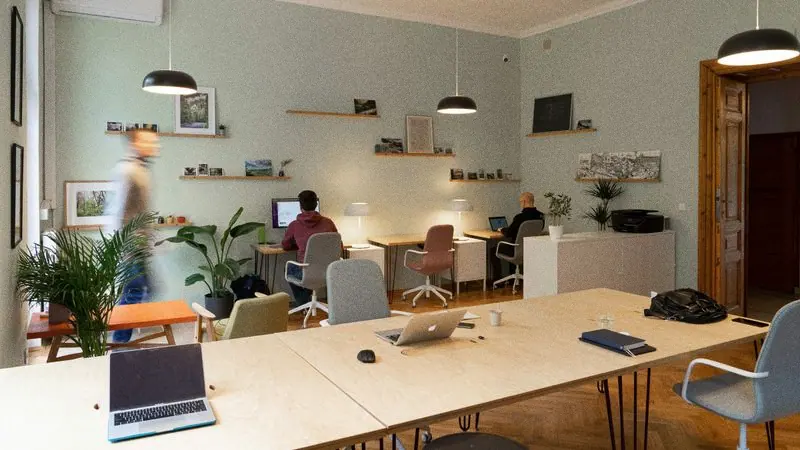
How to Stay Focused Working From Home: 5 Fixes That Hold

Short answer
Home takes away four things an office supplies without you noticing: other people working, a clear start and finish, a door between you and the household, and company. Replace each one on purpose with a start ritual, a written plan you can see, timed work blocks, interruption rules agreed with the people you live with, and working alongside others online. Research on remote work suggests the home itself is not the problem; the missing structure is.
Key takeaways
- In a nine-month randomised experiment at a Chinese travel agency, call-centre staff working from home performed 13% better than those in the office, so home is not automatically worse for output.
- The famous 23 minutes figure is the average time before people returned to an interrupted task on the same day, usually after about two other tasks, not the time it takes to refocus.
- In Gloria Mark's observations, people interrupted themselves about 44% of the time, so blocking other people is only half the job.
- A plan in the form 'when X happens, I will do Y' had a medium to large effect on goal attainment across 94 tests, which is the case for a fixed start ritual.
- In Buffer's 2023 survey of remote workers, 23% named loneliness and 22% named not being able to unplug as struggles, so plan for company and for a hard stop.
- Agree interruption rules with your household in advance: a visible signal, set check-in times, and a short list of what counts as urgent.
To stay focused working from home, rebuild the structure an office gives you for free. Start at a fixed time with the same short ritual, keep today's plan where you can see it, work in timed blocks, agree interruption rules with the people you live with, and spend part of the day working alongside someone else online. Willpower is not the missing ingredient. Cues are.
better performance from call-centre staff randomly assigned to work at home for nine months.
Bloom et al., NBER, 2013of interruptions were people interrupting themselves, in Gloria Mark's observations of office workers.
Gallup interview, 2006independent tests in the meta-analysis that found if-then plans help people reach goals.
Gollwitzer and Sheeran, 2006Short on time? Jump to the start ritual or the day plan.
Why is it harder to focus at home than in an office?
An office does a lot of quiet work on your behalf. Home does none of it, so each piece has to be replaced on purpose.
| What the office gave you | What happens at home | The fix |
|---|---|---|
| People around you working | No social cue to start or keep going | Work alongside others online |
| A commute and a set start time | The day blurs in from breakfast | A start ritual at a fixed time |
| Meetings and colleagues who shape the day | A vague list and a long open afternoon | A visible plan and time blocks |
| A building between you and the household | Deliveries, laundry, family, housemates | Agreed interruption rules |
| Leaving the building | Work leaks into the evening | A hard stop and a shutdown routine |
None of this means home is a worse place to work. It means home is an unfurnished one.
Does working from home hurt productivity?
The better evidence says no, with caveats.
In a well-known experiment, Stanford economist Nicholas Bloom and colleagues randomly assigned volunteer call-centre staff at Ctrip, a large Chinese travel agency, to work from home or in the office for nine months. Home working led to a 13% performance increase: about 9% from working more minutes per shift (fewer breaks and sick days) and 4% from more calls per minute, which the authors attribute to a quieter working environment. There was a cost: the home workers' promotion rate, conditional on performance, fell. And when the company later let everyone choose, over half of the experimental employees switched arrangement, which is a reminder that home suits some people and not others.
The paper splits the gain into its two parts:
Show the numbers
| Group | More minutes worked per shift | More calls per minute |
|---|---|---|
| Home workers against office workers | 9% | 4% |
Source: Bloom, Liang, Roberts and Ying, NBER Working Paper 18871
Bloom tells the story of the experiment himself in this talk.

A later randomised trial of 1,612 employees at a Chinese technology company found that a hybrid schedule with two home days a week did not affect performance grades and reduced quit rates by one-third.
Two limits matter. Both studies come from single companies in China, and call-centre work is measured in a way most knowledge work is not. Treat them as proof that home working can go well, not a promise that it will.
What people say they struggle with is revealing. In Buffer's 2023 survey of about 3,000 remote workers, 33% said they stay home too often because they have no reason to leave, 23% named loneliness, 22% not being able to unplug, 20% staying motivated and 16% difficulty focusing. (It is a self-selected survey run by one company, so read the numbers as rough.) Focus is on the list, but isolation and blurred boundaries rank higher. Those are the problems worth designing around.
Show the numbers
| Struggle | Share of respondents |
|---|---|
| Staying home too often | 33% |
| Loneliness | 23% |
| Not being able to unplug | 22% |
| Staying motivated | 20% |
| Working across time zones | 19% |
| Difficulty focusing | 16% |
| Collaboration and communication | 15% |
Does it really take 23 minutes to refocus after an interruption?
This is the statistic most often quoted about interruptions, and it is usually misquoted.
It traces back to Gloria Mark, a researcher at the University of California, Irvine, who shadowed office workers and timed everything they did. In a 2006 interview with Gallup she said that 81.9% of interrupted work was resumed the same day, and that it was resumed "on average, in 23 minutes and 15 seconds". The published paper from that research, based on 24 information workers, reports slightly different figures: 77.2% resumed the same day, after an average of 25 minutes 26 seconds, with a very wide spread.
it was resumed, on average, in 23 minutes and 15 seconds, which I guess is not so long.
So the figure measures how long an interrupted task sat untouched before the person came back to it. It is not the time your brain needs to regain concentration. Mark's real point was different: before returning, people worked on about two other things, which makes it harder to pick up the thread.
Three other findings from her work are more useful at home:
- You are your own biggest interrupter. In the Gallup interview, Mark said people interrupted themselves about 44% of the time. At home, with no one watching, expect that share to matter more. Much of it is plain avoidance, which is the subject of how to stop procrastinating.
- Interruptions cost stress more than time. In a 2008 lab experiment with 48 participants, people who were interrupted during an email task finished it faster, with no difference in errors, but reported more stress, frustration, time pressure and effort after only 20 minutes.
- Unfinished tasks follow you. In two experiments, Sophie Leroy found that people find it hard to move their attention away from an unfinished task, and their performance on the next task suffers. She called this attention residue.
The practical reading: you will not stop every interruption, so make each one cheap to recover from. Before you answer the door, write one line saying what you were about to do next.
How do you start the working day at home?
With the same three or four actions, at the same time, every day. The ritual replaces the commute as the signal that work has begun.
There is decent evidence for deciding in advance exactly when and how you will act. A meta-analysis of 94 independent tests found that if-then plans, called implementation intentions, had a medium to large effect on goal attainment (d = .65). "When it is 9:00, I sit at the desk and open the document" is that kind of plan.
A start ritual you can copy:
- Leave the house for five minutes, or at least get dressed and make a drink. Something has to mark the change.
- Sit down at the same time each day.
- Phone on silent, in another room. (More on that in how to stop phone distraction.)
- Write today's three outputs on paper.
- Start a timer and begin the first one before opening email or chat.
Step five matters most. Opening the inbox first hands your morning to other people.
This morning's start ritual
Tick them off in order. Your ticks are saved in this browser, so clear them each morning.
Step three is the one people skip. If you doubt it matters, put your own numbers in.
What do your phone checks add up to in a working year?
Estimate how often you pick it up during work and for how long. It is arithmetic on your own numbers, not a research finding.
If the total surprises you, the phone deserves its own plan.
 How to Stop Phone Distraction While Studying
What should a work-from-home plan look like?
Short, physical and visible. A list inside an app in a closed tab does not count.
Write three outputs for the day as finished things, not activities: "send the budget draft to Priya", not "work on budget". Put the paper next to your keyboard. When you drift, which you will, the list is what brings you back without having to decide again what matters.
Then give the outputs a place in the day:
| Time | Block |
|---|---|
| 9:00 | Start ritual, plan on paper |
| 9:10 to 11:00 | Focus blocks on output one |
| 11:00 to 11:30 | Messages and email |
| 11:30 to 12:30 | Focus blocks on output two |
| 12:30 to 13:30 | Lunch away from the desk, outside if you can |
| 13:30 to 15:00 | Calls and meetings |
| 15:00 to 16:30 | Focus blocks on output three |
| 16:30 to 17:00 | Messages, tomorrow's three outputs, shutdown |
The same day as a strip, with the focus blocks broken into 25 minute rounds:
Show the numbers
| Schedule in minutes | |
|---|---|
| Morning | 10 other, 25 focus, 5 short break, 25 focus, 5 short break, 25 focus, 5 short break, 20 focus, 30 other, 25 focus, 5 short break, 25 focus, 5 short break |
| Afternoon | 60 long break, 90 other, 25 focus, 5 short break, 25 focus, 5 short break, 25 focus, 5 short break, 30 other |
Source: Example schedule
Inside a focus block, work in timed rounds. The standard Pomodoro pattern is 25 minutes of work and a 5 minute break; move to 50 and 10 once starting stops being the hard part. For demanding work that needs a long run, see deep work sessions, and for the evidence behind each length, the best Pomodoro intervals.
Your blocks will not be the same length as the ones above. Enter the time you really have and see how many rounds fit.
How many rounds fit in your block?
Enter how long you have and an interval. You get the rounds that fit, with the breaks.
Two smaller choices shape a block. Leave the desk on the breaks (ideas for a five minute break), and if the house is noisy, see what the research says about music while you work. When a block goes so well that you resent the bell, read about flow state before you start skipping breaks.
Batching messages into set windows is the single change that removes the most self-interruption. If your team expects instant replies, agree the windows with them first. There is a script for that in remote team focus time.
How do you stop household interruptions?
By agreeing rules before the day starts. A rule made in the moment sounds like a rejection. A rule made on Sunday evening is just the plan.
Cover three things:
- A visible signal. Door closed, headphones on, or a sign on the door means "in a block".
- When you will next be free. People wait far more easily for a known time than an unknown one.
- What counts as urgent. Name it, so nobody has to guess.
Scripts you can adapt:
To a partner: "I'm in focus blocks from 9 to 11 and 3 to 4:30. If the door is shut, text me unless it's urgent. I'll come out at 11 and I'm all yours for lunch."

To a child old enough to tell the time: "When the sign is red, I'm working. When the timer rings, I'll come and find you, and you can tell me everything."

To housemates: "I've got calls 1:30 to 3. Could we keep the kitchen quiet then? I'll be out of your way by 5."
Then keep your half of the bargain. If you promised 11:00, appear at 11:00. The rule only survives if the break is real.
With very young children, no script holds. Split shifts with another adult if you can, and put your hardest work in nap time.
How do you stay motivated working from home alone?
Put other people back into the day, even at a distance.
Working alongside someone else, in person or online, is often called body doubling. It is fair to say that formal research on it is thin; most of the support is practical experience, not controlled trials. But it targets exactly what home removes: someone else visibly at work, a time you have agreed to start, and a person to tell what you got done.
A simple routine with a colleague or friend:
- Agree a start time.
- Each say in one sentence what you will finish this block.
- Work in silence on a shared timer.
- Report back at the break. Repeat.
If the same person turns up each time, you have an accountability partner. If you would rather do it online with strangers, that is virtual body doubling.
Doing this in Work Club
Work Club is a free shared timer room that runs in the browser. You type a name, get a link and a 6-character code, and send it to whoever you want to work with. Everyone sees the same timer (25 minutes of focus and a 5 minute break by default, and the room can change the lengths), and each person can show what they are working on. The chat is locked during focus and opens on breaks, which gives you the report-back moment without a channel to check mid-task.
It has no scheduled matching with strangers. Cameras and voice are both optional. If you need a partner booked for a set time, a video coworking service is the right tool; the options are compared in best virtual coworking apps and in our list of Focusmate alternatives.
 Body doubling: what it is and whether it works
Online company helps with starting. It does not replace seeing people. If a third of remote workers say they stay home too often, the fix for that is a lunch walk, a café morning or a regular day in a shared space.
How do you switch off at the end of the day?
Decide the stop time in the morning and treat it like a train you have to catch.
In the last 15 minutes: clear messages, write tomorrow's three outputs, note where you stopped on anything unfinished, close the laptop and put it out of sight. Writing down the next step for unfinished work is the cheapest answer to attention residue: the task is parked, not abandoned.
Then leave the room, or if the desk is in your living space, cover it. The office had a door. Make one.
If trouble concentrating is long-standing, shows up outside work too, or comes with low mood or poor sleep, routines may not be the whole answer. That is worth raising with a doctor.
Common questions
Why can't I focus when working from home?
Usually because the structure an office gives you is missing, not because you lack discipline. Nobody around you is working, the day has no clear start or end, the household can reach you at any moment, and you may go hours without speaking to anyone. Replacing those four things deliberately tends to work better than trying harder.
Does it really take 23 minutes to refocus after an interruption?
Not quite. Gloria Mark's field research found that interrupted work that was resumed the same day was picked up again after about 23 to 25 minutes on average, and people typically did about two other tasks in between. That is a measure of how long tasks stay abandoned, not a stopwatch on your concentration. Her 2008 lab study found interrupted people actually finished faster, but with more stress and frustration.
Are people less productive working from home?
The best experiments do not show that. A randomised trial at Ctrip found a 13% performance gain for home-based call-centre staff, and a 2024 randomised trial of 1,612 employees found that two home days a week had no effect on performance grades and cut quit rates by a third. Both were run at one company in China, so they show what is possible, not what will happen to you.
How do I stay motivated working from home alone?
Borrow the presence of other people. Work in a shared online session with a colleague or friend, say what you are going to do at the start, and report back at the break. Formal research on this practice, often called body doubling, is thin, but it costs nothing to try for a week and see whether your start times improve.
How do I stop family or housemates interrupting me?
Agree the rules before the working day, not in the moment. Use a visible signal such as a closed door or headphones, tell people exactly when you will next be free, and define what counts as urgent. Then keep your side of the deal by actually appearing at the promised time.
How long should a focus block be at home?
Start with 25 minutes of work and a 5 minute break, which is the standard Pomodoro pattern, and lengthen to 50 minutes once starting is no longer the hard part. The right length is the longest one you can protect from interruption. A shorter block you finish beats a long one that gets broken twice.
Sources
- Does Working from Home Work? Evidence from a Chinese Experiment, National Bureau of Economic Research (published in The Quarterly Journal of Economics, 2015) (2013)
- Hybrid working from home improves retention without damaging performance, Nature (2024)
- 2023 State Of Remote Work, Buffer (2023)
- No Task Left Behind? Examining the Nature of Fragmented Work, Proceedings of CHI 2005 (University of California, Irvine) (2005)
- Too Many Interruptions at Work?, Gallup Business Journal (2006)
- The Cost of Interrupted Work: More Speed and Stress, Proceedings of CHI 2008 (University of California, Irvine) (2008)
- Why is it so hard to do my work? The challenge of attention residue when switching between work tasks, Organizational Behavior and Human Decision Processes (2009)
- Implementation Intentions and Goal Achievement: A Meta-analysis of Effects and Processes, Advances in Experimental Social Psychology (2006)
Published 12 November 2026. Last checked and updated 13 November 2026. See how these guides are written.