The Pomodoro Technique: What It Is and How It Works
Short answer
The Pomodoro Technique is a time management method created by Francesco Cirillo in the late 1980s. You work on one task for 25 minutes, take a 5 minute break, and take a longer break of 15 to 30 minutes after every four rounds. The few controlled studies that exist are small and mixed, so treat it as a useful structure to try, not a proven best way to work.
Key takeaways
- A classic pomodoro is 25 minutes of work on one task plus a 5 minute break, with a 15 to 30 minute break after every four.
- In Cirillo's rules a pomodoro is indivisible: if an interruption takes you away from the task, that pomodoro is void and you start a new one.
- Interruptions are written down and rescheduled, using what Cirillo calls the inform, negotiate, call back strategy.
- Controlled studies of Pomodoro-style breaks are few, short and based on students, and their results on mood and fatigue point in different directions.
- No study so far has shown that timed breaks improve how much people get done compared with choosing their own breaks.
- Cirillo himself says the count of pomodoros is not the goal and that the ideal length is anywhere from 20 to 35 minutes.
The Pomodoro Technique is a time management method created by Francesco Cirillo in the late 1980s. You choose one task, work on it for 25 minutes without switching, take a 5 minute break, and after four rounds take a longer break of 15 to 30 minutes. Each 25 minute session is called a pomodoro. The research behind it is thinner than most guides admit, but it is a simple, low-risk way to get started on work and to make sure breaks happen.
Here is one full cycle laid out to scale, so you can see how little of it is break.
Show the numbers
| Schedule in minutes | |
|---|---|
| Four pomodoros, 15 minute long break | 25 focus, 5 short break, 25 focus, 5 short break, 25 focus, 5 short break, 25 focus, 15 long break |
| Four pomodoros, 30 minute long break | 25 focus, 5 short break, 25 focus, 5 short break, 25 focus, 5 short break, 25 focus, 30 long break |
Source: Arithmetic on Cirillo's default lengths, not measured data
If you would rather try it than read about it, start a round with the timer below. If the hard part is beginning at all, our guide on how to stop procrastinating covers that first step.
Where did the Pomodoro Technique come from?
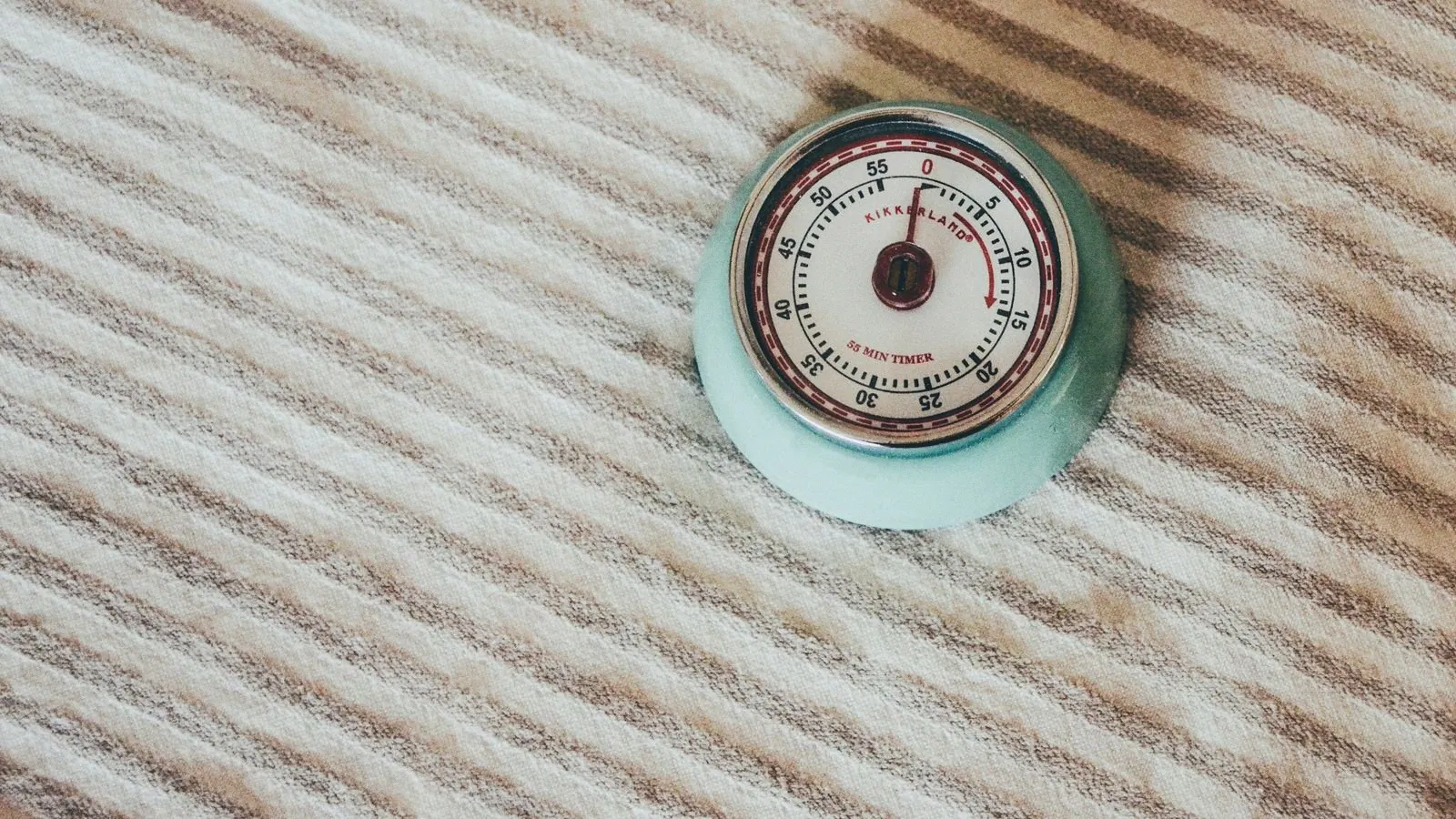
Francesco Cirillo developed it as a university student in Italy. On his own site he says he could not focus on his studies, so he set himself a small challenge with a tomato-shaped kitchen timer: could he study for just two minutes without interruption? Pomodoro is Italian for tomato, which is where the name comes from.
One detail varies between his own accounts. The site today says two minutes. His original 2006 paper frames the first bet as whether he could really study for 10 minutes. Either way, the starting point was a very short timed session, not 25 minutes.
Cirillo writes that the method spread in the 1990s through software teams he mentored, and then through a free PDF on his website before it became a published book.
He is also clear that the popular version is a shrunken one. His site describes the technique as a complete system for dealing with time that includes planning, estimating effort, recording and review, and he complains that apps and articles reduced it to "Work for 25 minutes, then take a break."
The timer is part of the practice, but the Technique is much more than a sequence of 25-minute sessions.
The shortest introduction from the source is Cirillo's own two-minute video.

How does the Pomodoro Technique work?
These are the core steps as Cirillo's 2006 paper sets them out. All you need is a timer, a pencil and paper.
- Plan. At the start of the day, write the tasks you intend to do on a "To Do Today" sheet.
- Set the timer for 25 minutes and start the first task.
- Work on that task only until the timer rings.
- Mark an X next to the task when it rings. That is one completed pomodoro.
- Take a 5 minute break. Stand up, walk around, drink water. Do nothing that takes real mental effort.
- Repeat. After every four pomodoros, take a longer break of 15 to 30 minutes.
- Record. At the end of the day, note how many pomodoros each task took, so tomorrow's estimates are better.
The paper lists five stages across the day: planning, tracking, recording, processing and visualising. Most people only do the middle part with the timer. The planning and recording steps are what turn it from a countdown into a method, because they show you how long your work really takes.
You can run your first round here without installing anything. Write one task on paper, then press start.
Try one pomodoro now
Pick one task, work on only that until the bell, then mark an X on your sheet. The classic length is 25 minutes with a 5 minute break.
The paper half matters as much as the timer. This is a plain version of the daily sheet to copy.
TO DO TODAY (date: ______)
Task 1: ______________  estimate: __ pomodoros   done: X X
Task 2: ______________  estimate: __ pomodoros   done:
Task 3: ______________  estimate: __ pomodoros   done:

UNPLANNED AND URGENT
- ______________

Marks: X = finished pomodoro, ' = internal interruption, - = external interruption
End of day: pomodoros planned __  pomodoros done __
Two sizing rules from the paper help with planning:
- If a task will take more than 5 to 7 pomodoros, break it down into smaller tasks.
- If a task will take less than one pomodoro, add it up with other small tasks until they fill one.
What are the rules about interruptions?
This is the part most summaries skip, and it is the heart of the method. Cirillo's rule is that a pomodoro is indivisible. There are no half pomodoros and no pausing. In his words, "If a Pomodoro Begins, It Has to Ring."
He separates two kinds of interruption.
Internal interruptions
These come from you: the urge to check a message, look something up, get a snack, or start a different task.
- Put an apostrophe (') on your sheet to mark that it happened.
- Write the thought down, either under "Unplanned and Urgent" on today's list or in your longer task inventory.
- Go back to the task until the timer rings.
Writing it down is what lets you drop it. The thought is saved, so it does not need to be acted on now. The phone is the usual source of these urges, and moving it out of reach before the timer starts does more than willpower will; see how to stop phone distraction.

External interruptions
These come from other people: a colleague, a call, a message. Cirillo's strategy is inform, negotiate, call back:
- Inform the person that you are in the middle of something.
- Negotiate a time to deal with it.
- Call back when you said you would.
Mark a dash (-) on your sheet, note the task, and keep going. A script you can copy: "I'm in the middle of something until twenty past. Can I come to you then?"
Here are versions for the three places interruptions usually arrive.
In person:
"I'm in the middle of something until twenty past. Can I come to you then?"

In chat:
"Heads down until 10:25. I'll reply properly then. If it can't wait, call me."

Status line:
"Focusing until 10:25. Back for 5 minutes after that."
If most of your interruptions come from colleagues, agreeing shared quiet hours works better than fending people off one at a time. Our guide to focus time for remote teams shows how to set that up.
If the interruption wins
If you really do have to stop, the pomodoro is void. It does not count, you do not mark an X, and you start a new one later. The paper's last rule is a kind one: "The Next Pomodoro Will Go Better."
If you finish early
Keep going until the timer rings. Cirillo suggests using the remaining minutes to review what you did, make small improvements and note what you learned.
Does the Pomodoro Technique actually work?
Honest answer: nobody has shown that it does, and nobody has shown that it does not. The direct evidence is a few small, short studies with university students.
students in the most cited study, which tested 24/6 and 12/3 schedules for a single day.
Biwer et al., 2023students in the 2025 test of classic 25/5 against self-chosen breaks, 93% of them women.
Smits et al., 2025people across the 22 samples in the best review of short breaks in general.
Albulescu et al., 2022The study most often cited is Biwer and colleagues, 2023. Eighty-seven students at a Dutch university studied for one day under one of three conditions: breaks whenever they liked, a 6 minute break after every 24 minutes, or a 3 minute break after every 12 minutes. Students who chose their own breaks studied and rested for longer, and reported more fatigue and distraction and less concentration and motivation. There was no difference in how much of their work the groups completed.
A 2025 follow-up found the opposite pattern for fatigue. Smits, Wenzel and de Bruin gave 94 psychology students a two hour session with self-chosen breaks, classic 25/5 Pomodoro breaks, or "Flowtime" breaks. Fatigue rose faster in the Pomodoro group and motivation fell faster in both structured groups, although overall levels did not differ. Productivity, task completion and flow were the same across groups. The authors note the sample was small and 93% women.
The paper's own table of group averages shows how little separated the three groups on the outcome most people care about, which is finishing what they planned.
Show the numbers
| Break method | Planned tasks completed |
|---|---|
| Self-chosen breaks (25 students) | 70.3% |
| Pomodoro 25/5 (36 students) | 69.4% |
| Flowtime (33 students) | 67.1% |
The self-rated measures were just as close.
Show the numbers
| Rating | Self-chosen | Pomodoro 25/5 | Flowtime |
|---|---|---|---|
| Motivation | 2.86 | 2.73 | 2.59 |
| Productivity | 3.03 | 2.86 | 2.75 |
| Fatigue | 2.56 | 2.59 | 2.64 |
A 2026 experiment tested learning directly. Göksu, Wiradhany and de Bruin had 176 students read a text with either 12 minutes on and 3 minutes off, or self-chosen breaks. Test scores did not differ. Students choosing their own breaks reported more energy, concentration and motivation. Many students said the 12/3 schedule broke their flow, and that is half the usual pomodoro, so this says more about very short intervals than about 25/5.
A 2025 scoping review in BMC Medical Education gathered 32 studies and concluded that Pomodoro-style work improved focus and reduced fatigue. Read the details before leaning on it. It has a single author, most of the included studies were observational, the randomised evidence it describes totals 87 participants on 24/6 and 12/3 schedules (the same figures as the Biwer study), and the review itself rates the certainty of the evidence as moderate to low.
Research on short breaks in general is stronger. A 2022 meta-analysis in PLOS ONE pooled 22 samples (2,335 people) and found that breaks of up to 10 minutes gave small but reliable gains in energy and reductions in fatigue. The effect on performance was not statistically significant overall, and showed up only for less demanding tasks.
What you can fairly take from this:
- Short breaks help you feel less tired. That is reasonably well supported.
- Whether a fixed timer beats your own judgement is unsettled, and probably depends on the person and the task.
- No controlled study has shown that the technique makes people get more done.
So try it, and judge it on your own results.
What are the common mistakes?
- Chasing a high count. Cirillo says that even one pomodoro, or none, is fine, and that the goal is to become aware of what happens in your mind, not to complete pomodoros.
- Working through the break. His paper says not to use the 5 minutes for anything that needs real mental effort, such as important emails or work conversations. If you need ideas, see what to do on a Pomodoro break.
- Pausing the timer. A paused pomodoro is an interrupted one. Note the interruption and carry on, or void it.
- Starting without a list. With no chosen task, the first minutes go on deciding what to do.
- Tasks that are the wrong size. "Write dissertation" is not a pomodoro task. "Draft the methods section opening" is.
- Skipping the record. Without the Xs and the end-of-day note, you lose the information that improves your planning.
The checklist below turns those mistakes into a routine for one clean round.
One pomodoro, done by the rules
These restate Cirillo's rules from the sections above. Ticks are saved in this browser.
When does the Pomodoro Technique not fit?
- Work that needs long unbroken thought. The 2025 scoping review lists this as a limitation: fixed timing can interrupt flow on tasks needing sustained focus. If the bell keeps cutting you off mid-thought, try longer blocks. Our guide to Pomodoro intervals compares the options, and deep work sessions covers planning 90-minute blocks. If you often get absorbed and lose track of time, read about flow state before deciding the bell is the problem.
- Days that are mostly reactive. If your job is answering people as they arrive, you will void most pomodoros. Save the method for the protected part of your day. At home the interruptions are different but the fix is similar, as our guide to staying focused when working from home explains.
- Meetings and live collaboration. The timer has nothing to say about these.
- If the timer makes you tense. Cirillo's paper has a section on "ring anxiety", and the scoping review notes that reliance on timers might induce anxiety in some learners. A silent or hidden timer, or self-chosen breaks, may suit you better.
People with ADHD often ask whether it helps. The studies above did not test that, so there is no solid answer from research. We cover what is known in the Pomodoro Technique and ADHD. If attention problems are affecting your studies or work, a clinician is the right person to talk to.
To sort your own task into one of these cases, answer three questions.
Does the classic Pomodoro fit this task?
Three questions that apply the points above. It is a rule of thumb to test, not a diagnosis.
Your result
Use the classic 25/5
Short rounds make starting cheap, and the interruption rules will earn their keep. Write the task down, start the timer and follow the checklist above. For what to do in the 5 minutes, see Pomodoro break ideas.
Your result
Keep the method, lengthen the round
Cirillo's own range runs to 35 minutes, 40 at the most, and many people double it to 50/10 for writing or coding. Keep the rules about one task and written-down interruptions. Pomodoro intervals compares the lengths.
Your result
Drop the fixed bell
Try Flowtime: work until you want to stop, note the time, then take a break in proportion. On reactive days, keep the timer for one protected hour only. The planning and recording steps still work without a countdown.
What variations are there?
Cirillo's paper says the ideal pomodoro is 20 to 35 minutes long, 40 at the most, so adjusting the length is within the original method.
| Variation | Pattern | Suits |
|---|---|---|
| Classic | 25 minutes on, 5 off, long break after four | Getting started, admin, revision |
| Double | 50 on, 10 off | Writing, coding, problem sets |
| 52/17 | 52 on, 17 off | People who want longer breaks |
| 90-minute block | About 90 on, 20 to 30 off | One demanding task a day |
| Flowtime | Work until you want to stop, then break in proportion | People the bell irritates |
Where those numbers come from, and how to test which suits you, is covered in Pomodoro intervals. For revision specifically, see Pomodoro for studying.
 Best Pomodoro Intervals: 25/5 vs 50/10 vs 52/17 vs 90
Can you do the Pomodoro Technique with other people?
Yes. Cirillo's 2006 paper talks about pair and team pomodoros, and his site lists a "team process" built on shared working patterns and agreed moments for communication. It adds a caution worth keeping: the method "is not a tool for monitoring people."
A group version is simple:
- Everyone says or writes what they will work on.
- One timer runs for the whole group.
- Nobody talks during the pomodoro.
- Everyone breaks together and talks then.
The shared break does the job that "inform, negotiate, call back" does for one person. Questions wait for the bell because everyone knows when it will ring. Working quietly alongside someone else is also known as body doubling, which has little formal research behind it but which many people find helps them stay on task.
Work Club is a free browser tool built for this. One person creates a room and shares the link or a 6-character code, and everyone sees the same timer: 25 minutes of focus, 5 minute breaks and a 15 minute break after every fourth round by default, with lengths the room can change. Chat is locked during focus and opens on breaks. It has no task lists, so keep your To Do Today sheet on paper as Cirillo intended. Cameras and voice are optional; if you want a matched partner or a hosted session, one of the services in our Focusmate alternatives guide is a better fit.
There is more on the group approach in Pomodoro timer with friends, and if you would rather join a room that already exists, we compare the options in virtual study rooms.
 Pomodoro Timer With Friends: 4 Ways to Share One Clock
Common questions
Why is it called the Pomodoro Technique?
Pomodoro is the Italian word for tomato. Francesco Cirillo timed his first study sessions with a kitchen timer shaped like a tomato, and the name stuck. Each timed work session is called a pomodoro.
How long is a pomodoro?
The traditional pomodoro is 25 minutes of work followed by a 5 minute break. After four pomodoros you take a longer break of 15 to 30 minutes. Cirillo's 2006 paper says the workable range is 20 to 35 minutes, with 40 at the most.
What happens if I get interrupted during a pomodoro?
Note the interruption on paper and carry on if you can. If you truly have to stop and deal with it, Cirillo's rule is that the pomodoro is void, as if it had never started, and you begin a fresh one afterwards. You do not pause the timer and resume.
Is the Pomodoro Technique scientifically proven?
No. A handful of small studies with university students have compared Pomodoro-style breaks with self-chosen breaks. One found better mood and concentration with timed breaks, two later ones did not, and none found a difference in how much work got done. Research on short breaks in general does show they reduce fatigue.
How many pomodoros should I do in a day?
There is no official target. Cirillo writes that even one pomodoro, or none, is fine, because the aim is to notice how you work, not to collect a high count. Use your own record of a normal day as the baseline and adjust from there.
Can you do the Pomodoro Technique with other people?
Yes. Cirillo's original paper mentions pair and team pomodoros, and his site describes a team process built on shared working patterns. In practice a group shares one timer, works quietly during the 25 minutes and talks during the breaks.
Sources
- What Is the Pomodoro Technique?, Francesco Cirillo, pomodorotechnique.com (2026)
- Francesco Cirillo, Creator of the Pomodoro Technique, Francesco Cirillo, pomodorotechnique.com (2025)
- The Pomodoro Technique (The Pomodoro), Francesco Cirillo (2006 paper, archived from pomodorotechnique.com) (2006)
- Understanding effort regulation: Comparing 'Pomodoro' breaks and self-regulated breaks, British Journal of Educational Psychology (2023)
- Investigating the Effectiveness of Self-Regulated, Pomodoro, and Flowtime Break-Taking Techniques Among Students, Behavioral Sciences (MDPI) (2025)
- When to Take a Break: Comparing Effects of Systematic Short (Pomodoro) and Self-Regulated Breaks on Subjective Experience and Actual Learning, Behavioral Sciences (MDPI) (2026)
- Assessing the efficacy of the Pomodoro technique in enhancing anatomy lesson retention during study sessions: a scoping review, BMC Medical Education (2025)
- 'Give me a break!' A systematic review and meta-analysis on the efficacy of micro-breaks for increasing well-being and performance, PLOS ONE (2022)
Published 12 November 2026. Last checked and updated 13 November 2026. See how these guides are written.