The Eisenhower Matrix: How to Use It, With Examples

Short answer
The Eisenhower matrix sorts tasks by two questions, is it urgent and is it important, into four boxes: do now, schedule, delegate or shrink, and drop. Eisenhower never drew it. In a 1954 speech he quoted an unnamed former college president on urgent and important problems, and Stephen Covey's 1989 book turned the distinction into four quadrants. Its real use is protecting important work that has no deadline, which experiments on the mere urgency effect show people neglect.
Key takeaways
- The matrix asks two separate questions of every task: does it have a real deadline soon, and does it serve a goal you chose.
- Eisenhower's 1954 remark was a quotation from an unnamed former college president, and it says the urgent and the important never overlap, which is not what the matrix shows.
- Stephen Covey's The 7 Habits of Highly Effective People (1989) turned the distinction into four quadrants; FranklinCovey's page on the habit does not mention Eisenhower.
- The quadrant that matters most is important but not urgent: revision plans, health, long projects. It only happens if you give it a time.
- Five experiments published in 2018 found that people choose lower-payoff tasks when those tasks merely appear urgent, and more so when they feel busy.
- The matrix fails when everything lands in the first box; at that point the problem is too many commitments, not poor sorting.
The Eisenhower matrix is a four-box grid that sorts tasks by two questions: is it urgent, and is it important? Urgent and important tasks are done now, important but not urgent ones are given a time, urgent but unimportant ones are delegated or kept short, and the rest are dropped. Its purpose is to stop deadlines and notifications from crowding out the work that matters most to you, and the name on it is partly a historical accident.
| Urgent | Not urgent | |
|---|---|---|
| Important | 1. Do now. Essay due tomorrow, a client's system down, a bill due today | 2. Schedule. Revision plan, exercise, the long project, learning a skill |
| Not important | 3. Delegate, shrink or batch. Most messages, routine requests, some meetings | 4. Drop. Scrolling, busywork, things you agreed to out of politeness |
To sort your own list straight away, open the Eisenhower matrix tool, or copy the paper template below.
The Eisenhower matrix explained
The grid depends on keeping two ideas apart that feel the same in the moment.
- Urgent is about time. FranklinCovey, the company that carries on Stephen Covey's work, puts it this way: whether something is urgent "depends on how soon it needs to be done".
- Important is about purpose. On the same page, important things "contribute to our mission, values, and high-priority goals".
A ringing phone is urgent whether or not the call matters. A revision plan for exams eight weeks away matters a great deal and nothing happens today if you ignore it. The matrix exists for that second kind of task. FranklinCovey's summary is that the best return on your time comes from things that are not urgent but are important, and it gives planning, creative thinking, learning and renewal as examples.
Each box comes with a verb:
- Do what is urgent and important, today.
- Schedule what is important and not urgent. Give it a date and a start time.
- Delegate what is urgent and not important, or make it smaller.
- Delete what is neither.
Where does the Eisenhower matrix come from?
Not from a diagram drawn by Dwight Eisenhower. The trail has two documented steps.
The 1954 speech
On 19 August 1954, President Eisenhower spoke at the Second Assembly of the World Council of Churches, held on the campus of Northwestern University in Evanston, Illinois. The transcript at the American Presidency Project shows he introduced the line as "the statement of a former college president", and then gave it:
I have two kinds of problems, the urgent and the important. The urgent are not important, and the important are never urgent.
Three things about this are usually lost.
First, it is a quotation. Eisenhower did not claim the words. Quote Investigator, which traced the saying, found no earlier source and could not identify the college president. Eisenhower mentioned Northwestern's president, J. Roscoe Miller, in the same breath, but only as someone who would understand the remark.
Second, the familiar wording, "what is important is seldom urgent and what is urgent is seldom important", is not in the transcript. Quote Investigator found "seldom" versions attached to Eisenhower's name from later in 1954 onwards, and suggests they may come from a faulty retelling of the speech.
Third, the remark describes two kinds of problem that never overlap. A grid with a box for tasks that are both urgent and important says something different. Eisenhower went on to call it "a dilemma of modern man". He was talking about attention to important things, not about sorting a to-do list.
Covey's four quadrants
The grid most people know comes from Stephen Covey's The 7 Habits of Highly Effective People, first published in 1989, where it belongs to Habit 3, "Put First Things First". FranklinCovey still teaches it as the four quadrants of time management. Its page on the habit does not mention Eisenhower at all.
At some point the general's name was attached to the consultant's grid. We could not find who first called it the Eisenhower matrix, or any primary source showing Eisenhower sorting tasks into four boxes, in the war or in the White House.
the year of the speech in which Eisenhower quoted a former college president on urgent and important problems.
The American Presidency Projectexperiments in the 2018 paper showing people pick lower-payoff tasks that merely seem urgent.
Zhu, Yang and Hsee, 2018of 31,000 workers surveyed in 2023 said they lack enough uninterrupted focus time in the workday.
Microsoft Work Trend Index, 2023How to use the Eisenhower matrix, step by step
- Empty your head onto one list. Everything, from "revise chapter 6" to "reply to landlord". Do not sort yet.
- Ask the urgency question. Is there a real deadline in the next day or two, with a consequence if it is missed? A notification is not a deadline.
- Ask the importance question. Does this serve a goal you chose: a grade, a project, your health, a person you care about? If it mainly serves someone else's convenience, it is probably not important to you.
- Place every task in a box. If you hesitate between two, put it in the lower-priority one and see whether anything bad happens.
- Act by box. Do box 1 today. Give each box 2 task a date and a start time. Shrink, batch or hand over box 3. Cross out box 4.
- Cap box 1. More than three or four items means some are not truly urgent, or the week is overcommitted.
- Review weekly. Tasks drift from box 2 to box 1 when they are left alone.
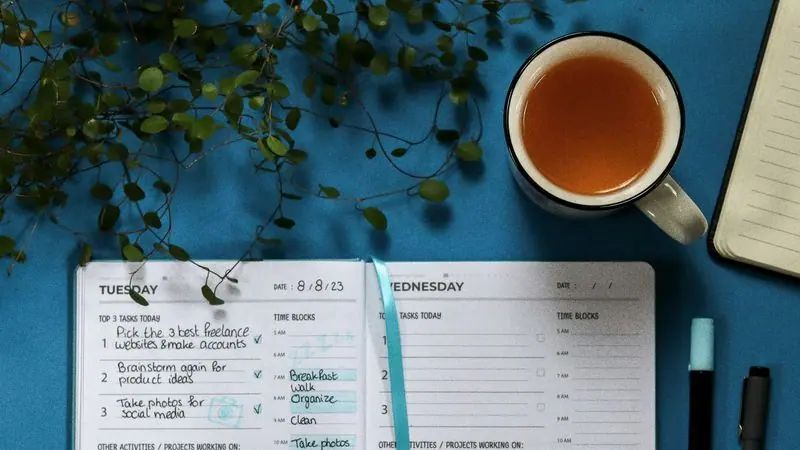
Step 5 is where most people stop too early. A box 2 task with no time attached is a wish. Put it on the calendar as a block, which is what time blocking is for, and consider doing it before anything else in the day, the approach known as eating the frog.
 Time Blocking: How to Plan Your Day in Blocks
Eisenhower matrix examples for students and for work
Here are twelve common tasks, sorted. Filter by the box or by who you are.
Where would this task go?
Worked examples, not rules. The same task can belong in a different box for you, depending on your goals and deadlines.
A real deadline and it counts towards the grade. Do it today, before anything else.
The slot disappears and the meeting affects your dissertation. Two minutes, now.
Nothing happens if you skip it today, and everything depends on it. Give it an hour this week.
Classic second-box work. Book two sessions now or it will arrive in the first box the night before.
Feels urgent because it keeps pinging. Vote once, mute the thread, check it at the end of the day.
Pleasant and neither urgent nor important. Drop it, or keep it for a break.
Deadline today, real consequences. This is what the first box is for.
No one is chasing it yet and your next six months depend on it. Schedule two focus blocks.
Important, never urgent. Ten minutes to book it, then it has a date.
Urgent to them, minor to your goals. Send three lines or point them to the shared document.
Ask for the notes instead, or send someone who needs to be there.
It produces a feeling of progress and nothing else. Drop it.
Nothing matches all of those. Remove a filter.
What if you have no one to delegate to?
Most students, freelancers and junior staff cannot hand work to anyone. Read the third box as shrink, batch or ask:
- Shrink. Answer in two lines instead of two paragraphs. If the reply takes under two minutes, the two-minute rule says to do it and move on, as long as you are not in the middle of focused work.
- Batch. Do all small admin in one sitting a day, so it interrupts you once.
- Ask. Split group tasks properly, or say no. A script helps.
Thanks for thinking of me. I can't take this on before [date],
because I'm finishing [the important thing].

Two options: I can look at it on [day], or [name / the shared doc]
may be able to help sooner. Which would you prefer?
An Eisenhower matrix template you can copy
Paste this into a notes app, or draw a cross on a sheet of paper and label the boxes.
WEEK OF:

1. DO NOW (urgent + important). Max 4.
-
-

2. SCHEDULE (important, not urgent). Each one gets a day and a time.
- ______________________  when: ________
- ______________________  when: ________
- ______________________  when: ________

3. SHRINK, BATCH OR DELEGATE (urgent, not important)
- ______________________  how: two-line reply / batch at 4pm / ask ____
-

4. DROP (neither)
-
-

Check: is anything in box 2 missing a time?
The weekly sort
Ten minutes, once a week. Ticks are saved in this browser.
Why do urgent tasks win? The research
Nobody has run a trial of the Eisenhower matrix itself that we could find. The problem it addresses is well documented.
The clearest evidence is a 2018 paper in the Journal of Consumer Research, The Mere Urgency Effect, by Meng Zhu, Yang Yang and Christopher Hsee. Across five experiments, people were more likely to work on unimportant tasks with objectively lower payoffs when those tasks were merely made to look urgent, for example through an illusion that they would expire. The authors say people behave as if pursuing an urgent task has its own appeal.
Two details from the Johns Hopkins account of the study matter for daily use. The effect was stronger in people who see themselves as generally busy. And in one experiment, reminding people of the payoffs at the moment they chose a task weakened it. Sorting your list by importance once a week is a reminder of exactly that kind.
A related habit is choosing easy tasks when the load is heavy. In a study of emergency doctors described by Kellogg Insight, a busier shift made doctors more likely to pick up easier cases, which felt like progress and went with weaker long-term performance.
Modern work supplies the urgency. Microsoft's 2023 Work Trend Index measured how time in its office apps is divided.
Show the numbers
| Measure | Communicating | Creating |
|---|---|---|
| Share of time in Microsoft 365 apps | 57% | 43% |
Source: Microsoft Work Trend Index, 2023
The figure comes from one company's products over 28 days in early 2023, and it leaves out all work done elsewhere. The accompanying survey is where the 68% without enough focus time comes from. If messages are the main source of false urgency for you, the fixes are in our guides to staying focused when you work from home and to phone distraction.
Using the Eisenhower matrix for time management
The matrix decides what deserves your time. It does not find the time. Pair it with a schedule.
This is an invented example of the shift people aim for when they start sorting weekly: the same 40 hours, with box 3 and box 4 trimmed to make room for box 2.
Show the numbers
| Week | 1. Do now | 2. Schedule | 3. Shrink | 4. Drop |
|---|---|---|---|---|
| Before | 12 h | 6 h | 14 h | 8 h |
| After | 12 h | 14 h | 9 h | 5 h |
Source: Example, not measured data
In a day, that looks like box 2 getting the first and best block, box 1 the next, and box 3 a short batch in the afternoon.
Show the numbers
| Schedule in minutes | |
|---|---|
| 09:00 to 16:00 | 90 focus, 15 short break, 75 focus, 45 long break, 60 other, 15 short break, 90 focus, 30 other |
Source: Example schedule
For students, the calendar side is covered in how to make a study schedule, and the exam countdown shows how many study days are really left, which is often what moves revision out of box 2. Lay the day out with the time blocking planner. For the focus blocks themselves, see deep work sessions.
 Eat the Frog: What It Means and How to Do It
Is there an Eisenhower matrix app?
You do not need a dedicated one. Three options, in order of effort:
- Paper. A cross on a page, redrawn weekly. Fast, and you see everything at once.
- A free web tool. Our Eisenhower matrix tool sorts tasks into the four quadrants and saves them in your browser, with no account.
- Your existing to-do app. Most let you add priority flags or tags. Four tags (do, schedule, shrink, drop) reproduce the matrix without moving your tasks anywhere new.
Choose whichever you will open every week. The weekly sort does the work, not the software.
Sort this week's tasks now
Add a task, pick its box, and move it if you change your mind. The list stays in this browser.
When the Eisenhower matrix fails, and what to use instead
- Everything is in box 1. If every task is urgent and important, sorting will not help. You have more commitments than hours, and something has to be renegotiated or dropped. If that has gone on for weeks and you feel exhausted or detached, read about study burnout and talk to a tutor, a manager or a doctor.
- You cannot tell what is important. The matrix assumes you know your goals. If you do not, start there: one sentence per course or project on what a good outcome looks like.
- Two categories are too crude. A task due in two days and one due in two hours are both "urgent". When the list is all deadlines, as in exam season, simply order tasks by date and size. Our guide to studying for exams has a plan for that.
- Sorting becomes procrastination. Re-sorting the same list is a way of not starting. If you already know the one task that matters, skip the grid and start it.
- You are too busy to notice urgency is fake. That is the mere urgency effect at work. A shorter list helps more than a better grid: pick tomorrow's single most important task tonight.
Protecting box 2 with other people
Important work without a deadline is easier to do when someone else expects you to turn up for it. Agree a time with an accountability partner, name the box 2 task each of you will work on, and start together.
In Work Club, a room shares one timer and the chat is locked for everyone during focus, then opens on the break. That keeps box 3 messages out of the block without anyone having to police it. Work Club has no task list, so the matrix stays on your paper or in the tool above.
Common questions
What is the Eisenhower matrix?
It is a two-by-two grid for prioritising tasks. One axis is urgent or not urgent, the other is important or not important. Urgent and important tasks are done first, important but not urgent tasks are scheduled, urgent but unimportant tasks are delegated or kept short, and tasks that are neither are dropped.
Did Eisenhower invent the Eisenhower matrix?
No evidence shows that he did. In a speech on 19 August 1954 he quoted an unnamed former college president who said he had two kinds of problems, the urgent and the important. The four-quadrant grid was popularised by Stephen Covey's 1989 book The 7 Habits of Highly Effective People.
What are the four quadrants of the Eisenhower matrix?
Urgent and important (do it now), important but not urgent (schedule it), urgent but not important (delegate it or keep it brief), and neither urgent nor important (drop it). The second quadrant is where planning, learning and long projects sit.
How do students use the Eisenhower matrix when they cannot delegate?
Treat the third box as shrink, batch or ask. Answer the message in two lines, handle all the small admin in one sitting, ask a group member to take a share, or say no. Students rarely have someone to hand work to, but most urgent and unimportant tasks can be made smaller.
Is there an Eisenhower matrix app?
You do not need one. A sheet of paper divided into four works, and so does any to-do app that lets you tag tasks. Work Club's free Eisenhower matrix tool sorts tasks into the four quadrants in your browser and saves them there.
How often should I redo the matrix?
Sort once a week when you plan, and glance at it each morning. Tasks move: an important essay with a distant deadline becomes urgent if it is left alone, which is the situation the matrix is meant to prevent.
Sources
- Address at the Second Assembly of the World Council of Churches, Evanston, Illinois, The American Presidency Project, UC Santa Barbara (1954)
- What Is Important Is Seldom Urgent and What Is Urgent Is Seldom Important, Quote Investigator (2014)
- Habit 3: Put First Things First, FranklinCovey (2026)
- The Mere Urgency Effect, Journal of Consumer Research (2018)
- People tend to choose impractical and ineffective approaches to tasks and deadlines, studies find, Johns Hopkins University, via Medical Xpress (2018)
- Will AI Fix Work? 2023 Work Trend Index Annual Report, Microsoft WorkLab (2023)
- Why You Should Skip the Easy Wins and Tackle the Hard Task First, Kellogg Insight, Northwestern University (2019)
Published 14 November 2026. Last checked and updated 14 November 2026. See how these guides are written.